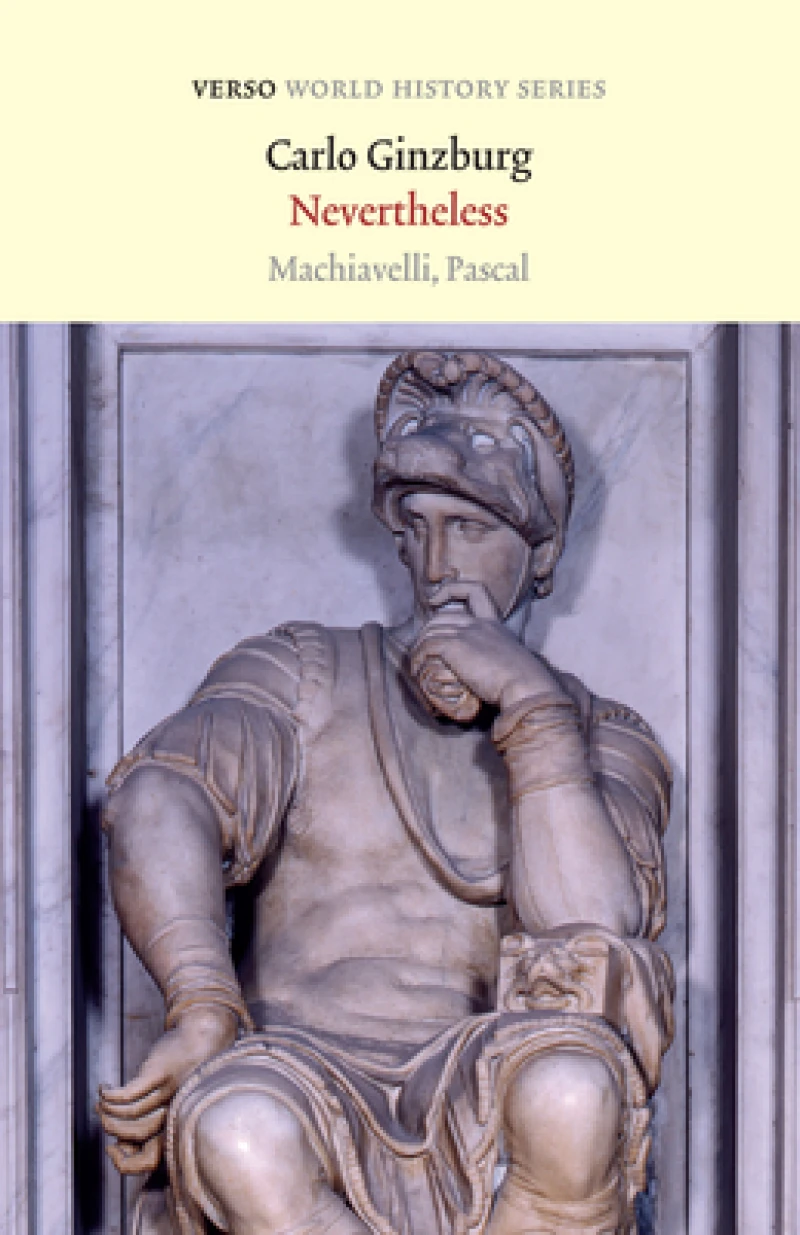
Nevertheless : Machiavelli, Pascal
Book Details
Format
Paperback / Softback
Book Series
Verso World History
ISBN-10
1839760141
ISBN-13
9781839760143
Publisher
Verso Books
Imprint
Verso Books
Country of Manufacture
GB
Country of Publication
GB
Publication Date
Jan 25th, 2022
Print length
272 Pages
Weight
338 grams
Dimensions
21.90 x 23.40 x 1.90 cms
Ksh 4,650.00
Werezi Extended Catalogue
Delivery in 7 days
1 copies in stock
Delivery Location
Delivery fee: Select location
Delivery in 7 days
Secure
Quality
Fast
From the master of "micro-history", a reconstruction of two contrasting early-modern thinkers
From the master of "micro-history" a reconstruction of two contrasting early-modern thinkers
Nevertheless comprises essays on Machiavelli and on Pascal. The ambivalent connection between the two parts is embodied by the comma (,) in the subtitle: Machiavelli, Pascal. Is this comma a conjunction or a disjunction?
In fact, both. Ginzburg approaches Machiavelli''s work from the perspective of casuistry, or case-based ethical reasoning. For as Machiavelli indicated through his repeated use of the adverb nondimanco ("nevertheless"), there is an exception to every rule. Such a perspective may seem to echo the traditional image of Machiavelli as a cynical, "machiavellian" thinker. But a close analysis of Machiavelli the reader, as well as of the ways in which some of Machiavelli''s most perceptive readers read his work, throws a different light on Machiavelli the writer. The same hermeneutic strategy inspires the essays on the Provinciales, Pascal''s ferocious attack against Jesuitical casuistry.
Casuistry vs anti-casuistry; Machiavelli''s secular attitude towards religion vs Pascal''s deep religiosity. We are confronted, apparently, with two completely different worlds. But Pascal read Machiavelli, and reflected deeply upon his work. A belated, contemporary echo of this reading can unveil the complex relationship between Machiavelli and Pascal - their divergences as well as their unexpected convergences.
Nevertheless comprises essays on Machiavelli and on Pascal. The ambivalent connection between the two parts is embodied by the comma (,) in the subtitle: Machiavelli, Pascal. Is this comma a conjunction or a disjunction?
In fact, both. Ginzburg approaches Machiavelli''s work from the perspective of casuistry, or case-based ethical reasoning. For as Machiavelli indicated through his repeated use of the adverb nondimanco ("nevertheless"), there is an exception to every rule. Such a perspective may seem to echo the traditional image of Machiavelli as a cynical, "machiavellian" thinker. But a close analysis of Machiavelli the reader, as well as of the ways in which some of Machiavelli''s most perceptive readers read his work, throws a different light on Machiavelli the writer. The same hermeneutic strategy inspires the essays on the Provinciales, Pascal''s ferocious attack against Jesuitical casuistry.
Casuistry vs anti-casuistry; Machiavelli''s secular attitude towards religion vs Pascal''s deep religiosity. We are confronted, apparently, with two completely different worlds. But Pascal read Machiavelli, and reflected deeply upon his work. A belated, contemporary echo of this reading can unveil the complex relationship between Machiavelli and Pascal - their divergences as well as their unexpected convergences.
Get Nevertheless by at the best price and quality guaranteed only at Werezi Africa's largest book ecommerce store. The book was published by Verso Books and it has pages.