
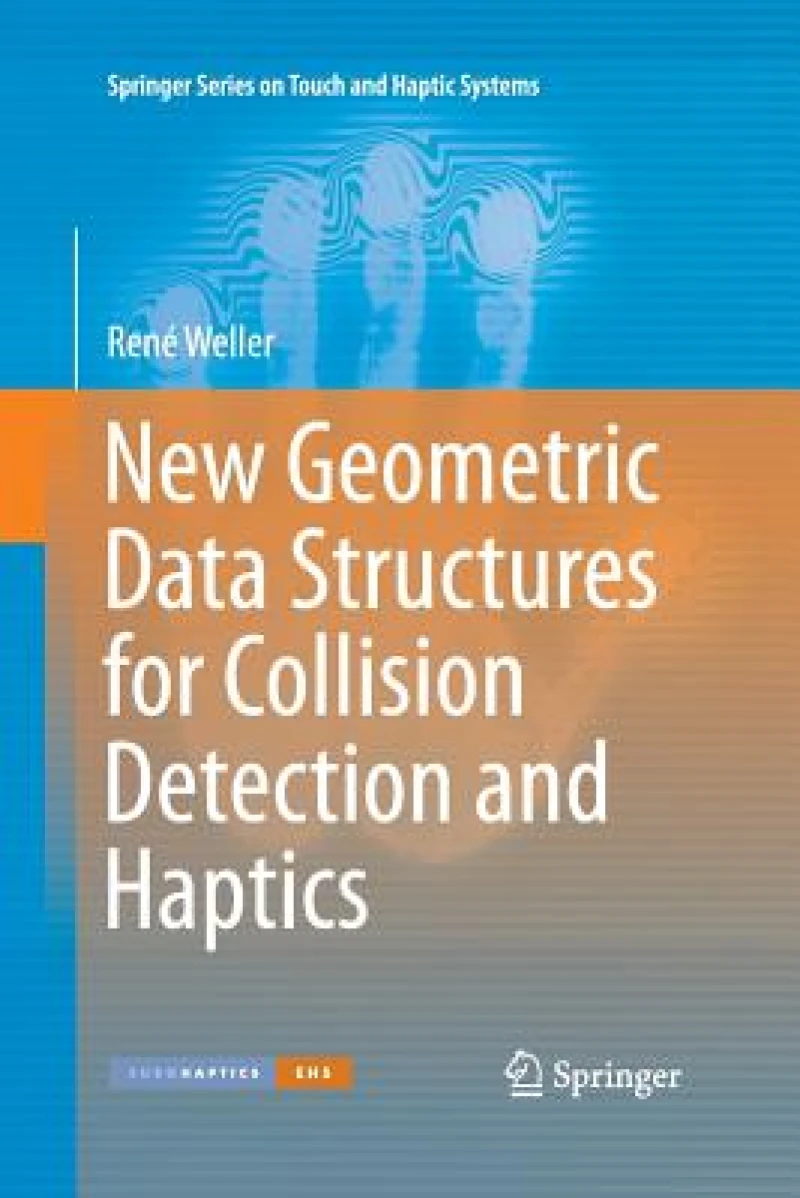
New Geometric Data Structures for Collision Detection and Haptics
Softcover reprint of the original 1st ed. 2013
by
Rene Weller
Book Details
Format
Paperback / Softback
Book Series
Springer Series on Touch and Haptic Systems
ISBN-10
3319033182
ISBN-13
9783319033181
Edition
Softcover reprint of the original 1st ed. 2013
Publisher
Springer International Publishing AG
Imprint
Springer International Publishing AG
Country of Manufacture
GB
Country of Publication
GB
Publication Date
Aug 8th, 2015
Print length
240 Pages
Ksh 8,100.00
Temporarily out of stock, due soon
0 in stock
Delivery Location
Delivery fee: Select location
Secure
Quality
Fast
This book features a novel geometric data structure for collision detection at haptic rates between arbitrary rigid objects. It offers a state of the art review of the current data structures for collision detection and presents new applications.
Starting with novel algorithms for optimally updating bounding volume hierarchies of objects undergoing arbitrary deformations, the author presents a new data structure that allows, for the first time, the computation of the penetration volume. The penetration volume is related to the water displacement of the overlapping region, and thus corresponds to a physically motivated and continuous force. The practicability of the approaches used is shown by realizing new applications in the field of robotics and haptics, including a user study that evaluates the influence of the degrees of freedom in complex haptic interactions. New Geometric Data Structures for Collision Detection and Haptics closes by proposing an open source benchmarking suite that evaluates both the performance and the quality of the collision response in order to guarantee a fair comparison of different collision detection algorithms. Required in the fields of computer graphics, physically-based simulations, computer animations, robotics and haptics, collision detection is a fundamental problem that arises every time we interact with virtual objects. Some of the open challenges associated with collision detection include the handling of deformable objects, the stable computation of physically-plausible contact information, and the extremely high frequencies that are required for haptic rendering. New Geometric Data Structures for Collision Detection and Haptics presents new solutions to all of these challenges, and will prove to be a valuable resource for researchers and practitioners of collision detection in the haptics, robotics and computer graphics and animation domains.
Get New Geometric Data Structures for Collision Detection and Haptics by at the best price and quality guaranteed only at Werezi Africa's largest book ecommerce store. The book was published by Springer International Publishing AG and it has pages.

