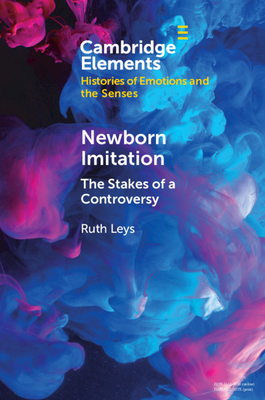
Newborn Imitation : The Stakes of a Controversy
by
Ruth Leys
Book Details
Format
Paperback / softback
Book Series
Elements in Histories of Emotions and the Senses
ISBN-10
1108826733
ISBN-13
9781108826730
Publisher
Cambridge University Press
Imprint
Cambridge University Press
Country of Manufacture
GB
Country of Publication
GB
Publication Date
Jul 30th, 2020
Print length
84 Pages
Weight
136 grams
Dimensions
15.10 x 23.00 x 0.70 cms
Product Classification:
Child & developmental psychologyChild, developmental and lifespan psychologyNeurosciences
KSh 3,250.00
Currently unavailable
0 in stock
Delivery Location
Delivery fee: Select location
Secure
Quality
Fast
Newborn imitation has recently become the focus of a major controversy in the human sciences. New studies have reexamined the evidence and found it wanting. This Element offers a critical assessment of the theories of newborn imitation and the stakes involved.
Newborn imitation has recently become the focus of a major controversy in the human sciences. New studies have reexamined the evidence and found it wanting. Imitation has been regarded as a crucial capability of neonates ever since 1977, when two American psychologists first published experiments appearing to demonstrate that babies at birth are able to copy a variety of facial movements. The findings overturned decades of assumptions about the competence of newborns. But what if claims for newborn imitation are not true? Influential theories about the mechanisms underlying imitation, the role of mirror neurons, the nature of the self and of infant mental states, will all have to be modified or abandoned if it turns out that babies cannot imitate at birth. This Element offers a critical assessment of those theories and the stakes involved.
Get Newborn Imitation by Ruth Leys at the best price and quality guaranteed only at Werezi Africa's largest book ecommerce store. The book was published by Cambridge University Press and it has 84 pages.
Customers Who Bought This Also Bought

The Anxious Generation
KSh 2,000.00
Restoring Childhood
KSh 3,050.00
Bible old testament bindup_8x8
KSh 2,450.00
The Einstein Syndrome
KSh 3,200.00
Restoring Childhood
KSh 4,500.00
Free to Learn
KSh 3,050.00
Key Issues in Childhood and Youth Studies
KSh 8,000.00
Key Issues in Childhood and Youth Studies
KSh 30,950.00
Outsmart Anxiety
KSh 4,700.00
How Children Succeed
KSh 3,400.00
Helping Children Succeed
KSh 3,050.00
The Life and Creative Works of Paulo Coelho
KSh 21,600.00