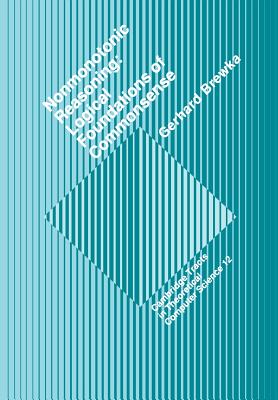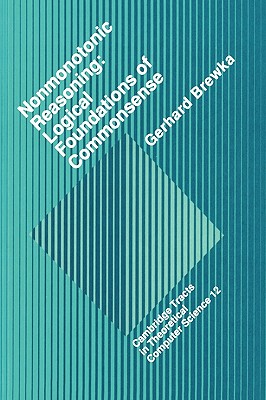
Nonmonotonic Reasoning : Logical Foundations of Commonsense
Book Details
Format
Hardback
Book Series
Cambridge Tracts in Theoretical Computer Science
ISBN-10
0521383943
ISBN-13
9780521383943
Publisher
Cambridge University Press
Imprint
Cambridge University Press
Country of Manufacture
GB
Country of Publication
GB
Publication Date
Jan 25th, 1991
Print length
184 Pages
Weight
500 grams
Dimensions
25.40 x 18.00 x 1.40 cms
Product Classification:
Artificial intelligenceArtificial intelligence (AI)
KSh 12,800.00
Currently unavailable
0 in stock
Delivery Location
Delivery fee: Select location
Secure
Quality
Fast
This 1991 book gives an overview of different areas of research in nonmonotonic reasoning. The guiding principles are: clarification of the different research activities in the area and appreciation of the fact that these research activities often represent different means to the same ends, namely sound theoretical foundations and efficient computation.
In this 1991 book the author gives a broad overview of different areas of research in nonmonotonic reasoning, and presents some results and ideas based on his research. The guiding principles are: clarification of the different research activities in the area, which have sometimes been undertaken independently of each other, and appreciation of the fact that these research activities often represent different means to the same ends, namely sound theoretical foundations and efficient computation. The book begins with a discussion of the various types of nonmonotonic reasoning, their applications and their logics. Theorem proving techniques for these logics are also described. There then follow chapters dealing with formulations of nonmonotonic inheritance, and nonmonotonic reasoning based on nonmonotonic rules. The final chapter discusses the achievements in the field in the light of the famous Yale shooting example. The book will be welcomed by researchers in theoretical computer science and artificial intelligence.
Get Nonmonotonic Reasoning by Gerhard Brewka at the best price and quality guaranteed only at Werezi Africa's largest book ecommerce store. The book was published by Cambridge University Press and it has 184 pages.
Customers Who Bought This Also Bought

Magnifica Humanitas
KSh 1,500.00

Nexus
KSh 2,350.00

The Thinking Machine
KSh 2,350.00

The Reverse Centaur's Guide to Life After AI
KSh 3,050.00

The MANIAC
KSh 2,000.00
Thinking With Machines: The Brave New World of AI
KSh 4,300.00
Prediction Machines
KSh 3,950.00

Confident AI
KSh 3,050.00

Responsible AI
KSh 6,400.00

Empire of AI
KSh 4,500.00

The MANIAC
KSh 2,700.00

Data Management, Analytics and Innovation
KSh 32,400.00