
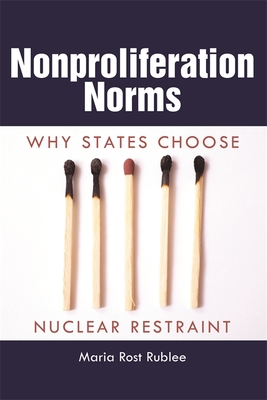
Nonproliferation Norms : Why States Choose Nuclear Restraint
Book Details
Format
Paperback / softback
Book Series
Studies in Security and International Affairs
ISBN-10
0820332356
ISBN-13
9780820332352
Publisher
University of Georgia Press
Imprint
University of Georgia Press
Country of Manufacture
US
Country of Publication
GB
Publication Date
Feb 15th, 2009
Print length
320 Pages
Weight
476 grams
Dimensions
22.90 x 15.20 x 2.00 cms
Product Classification:
Arms negotiation & controlArms negotiation and controlNuclear weapons
KSh 5,900.00
Currently unavailable
0 in stock
Delivery Location
Delivery fee: Select location
Secure
Quality
Fast
Offers bold policy prescriptions based on a sharpened knowledge of the many ways we transmit and process nonproliferation norms. Rublee argues that the social mechanisms that encourage nonproliferation—and the regime that created them—must be preserved, for without them states that have exercised nuclear restraint may rethink their choices.
Too often, our focus on the relative handful of countries with nuclear weapons keeps us from asking an important question: Why do so many more states not have such weapons? More important, what can we learn from these examples of nuclear restraint? Maria Rost Rublee argues that in addition to understanding a state's security environment, we must appreciate the social forces that influence how states conceptualize the value of nuclear weapons. Much of what Rublee says also applies to other weapons of mass destruction, as well as national security decision making in general. The nuclear nonproliferation movement has created an international social environment that exerts a variety of normative pressures on how state elites and policymakers think about nuclear weapons. Within a social psychology framework, Rublee examines decision making about nuclear weapons in five case studies: Japan, Egypt, Libya, Sweden, and Germany. In each case, Rublee considers the extent to which nuclear forbearance resulted from persuasion (genuine transformation of preferences), social conformity (the desire to maximize social benefits and/or minimize social costs, without a change in underlying preferences), or identification (the desire or habit of following the actions of an important other). The book offers bold policy prescriptions based on a sharpened knowledge of the many ways we transmit and process nonproliferation norms. The social mechanisms that encourage nonproliferation-and the regime that created them-must be preserved and strengthened, Rublee argues, for without them states that have exercised nuclear restraint may rethink their choices.
Get Nonproliferation Norms by Maria Rost Rublee at the best price and quality guaranteed only at Werezi Africa's largest book ecommerce store. The book was published by University of Georgia Press and it has 320 pages.
Customers Who Bought This Also Bought

Night of Power
KSh 3,800.00
How Sanctions Work
KSh 3,800.00
Arms Control
KSh 12,050.00

Nuclear Deterrence in the 21st Century
KSh 3,600.00
International Cooperation on WMD Nonproliferation
KSh 14,550.00
Norm Dynamics in Multilateral Arms Control – Interests, Conflicts, and Justice
KSh 8,050.00

Apocalyptic Crimes – Why Nuclear Weapons Are Illegal and Must Be Abolished
KSh 10,800.00
Regional Pathways to Nuclear Nonproliferation
KSh 12,000.00
Regional Pathways to Nuclear Nonproliferation
KSh 6,650.00
Norm Dynamics in Multilateral Arms Control
KSh 16,100.00
State Behavior and the Nuclear Nonproliferation Regime
KSh 27,550.00
Combating Weapons of Mass Destruction
KSh 16,750.00
