
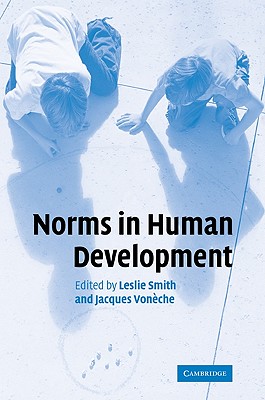
Norms in Human Development
Book Details
Format
Paperback / softback
ISBN-10
0521103290
ISBN-13
9780521103299
Publisher
Cambridge University Press
Imprint
Cambridge University Press
Country of Manufacture
GB
Country of Publication
GB
Publication Date
Mar 19th, 2009
Print length
304 Pages
Weight
462 grams
Dimensions
15.10 x 22.60 x 2.40 cms
Product Classification:
PhilosophyChild & developmental psychologyChild, developmental and lifespan psychologyPhilosophy
KSh 6,300.00
Currently unavailable
0 in stock
Delivery Location
Delivery fee: Select location
Secure
Quality
Fast
The distinction between norms and facts is long-standing in providing a challenge for psychology. The central argument in this book is twofold. Firstly, the approach in twentieth-century psychology is flawed. Secondly, norms operating interdependently with causes can be investigated empirically and theoretically in cognition, culture and morality.
The distinction between norms and facts is long-standing in providing a challenge for psychology. Norms exist as directives, commands, rules, customs and ideals, playing a constitutive role in human action and thought. Norms lay down 'what has to be' (the necessary, possible or impossible) and 'what has to be done' (the obligatory, the permitted or the forbidden) and so go beyond the 'is' of causality. During two millennia, norms made an essential contribution to accounts of the mind, yet the twentieth century witnessed an abrupt change in the science of psychology where norms were typically either excluded altogether or reduced to causes. The central argument in this book is twofold. Firstly, the approach in twentieth-century psychology is flawed. Secondly, norms operating interdependently with causes can be investigated empirically and theoretically in cognition, culture and morality. Human development is a norm-laden process.
Get Norms in Human Development by Jacques Voneche at the best price and quality guaranteed only at Werezi Africa's largest book ecommerce store. The book was published by Cambridge University Press and it has 304 pages.
Customers Who Bought This Also Bought

Decolonizing Language and Other Revolutionary Ideas
KSh 2,350.00

How to Read a Book
KSh 2,000.00
Decolonizing Language and Other Revolutionary Ideas
KSh 3,600.00

Creative Act
KSh 3,250.00

Groundwork for the Metaphysics of Morals
KSh 2,000.00

Things in Nature Merely
KSh 2,000.00

Meditations – The Philosophy Classic
KSh 2,150.00

Great Ideas Social Contract
KSh 1,450.00

How to Be a Leader – An Ancient Guide to Wise Leadership
KSh 2,800.00

The Daily Laws
KSh 2,350.00

Three Critiques, 3-volume Set
KSh 14,000.00

Philosophical Dictionary
KSh 2,700.00