
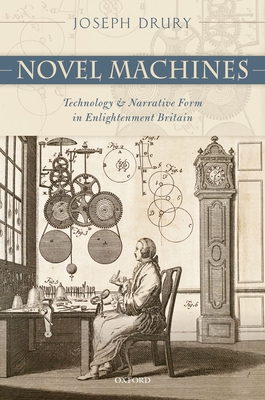
Novel Machines : Technology and Narrative Form in Enlightenment Britain
by
Joseph Drury
Book Details
Format
Hardback
ISBN-10
0198792387
ISBN-13
9780198792383
Publisher
Oxford University Press
Imprint
Oxford University Press
Country of Manufacture
GB
Country of Publication
GB
Publication Date
Nov 30th, 2017
Print length
286 Pages
Weight
552 grams
Dimensions
16.70 x 24.20 x 2.40 cms
Product Classification:
Literary studies: c 1500 to c 1800Literary studies: fiction, novelists & prose writers
KSh 19,900.00
Currently unavailable
0 in stock
Delivery Location
Delivery fee: Select location
Secure
Quality
Fast
Novel Machines explores the ideas of technological modernity and the machinery of narrative fiction in the eighteenth-century British novel.
Eighteenth-century fiction is full of mechanical devices and contrivances: Robinson Crusoe uses his gun and compass to master his island and its inhabitants; Tristram Shandy''s conception is interrupted by a question about a clock and he has his nose damaged at birth by a man-midwife''s forceps; Ann Radcliffe''s gothic heroines play musical instruments to soothe their troubled minds. In Novel Machines, however, Joseph Drury argues that the most important machine in any eighteenth-century novel is the narrative itself. Like other kinds of machine, a narrative is an artificial construction composed of different parts that combine to produce a sequence of causally linked actions. Like other machines, a narrative is designed to produce predictable effects and can therefore be put to certain uses. Such affinities had been apparent to critics since Aristotle, but they began to assume a particular urgency in the eighteenth century as authors sought to organize their narratives according to the new ideas about nature, art, and the human subject that emerged out of the Scientific Revolution. Reading works by Eliza Haywood, Henry Fielding, Laurence Sterne, and Ann Radcliffe, Novel Machines tracks the consequences of the effort to transform the novel into an Enlightenment machine. On the one hand, the rationalization of the novel''s narrative machinery helped establish its legitimacy, such that by the end of the century it could be celebrated as a modern ''invention'' that provided valuable philosophical knowledge about human nature. On the other hand, conceptualizing the novel as a machine opened up a new line of attack for the period''s moralists, whose polemics against the novel were often framed in the same terms used to reflect on the uses and effects of machines in other contexts. Eighteenth-century novelists responded by adapting the novel''s narrative machinery, devising in the process some of the period''s most characteristic and influential formal innovations.
Get Novel Machines by Joseph Drury at the best price and quality guaranteed only at Werezi Africa's largest book ecommerce store. The book was published by Oxford University Press and it has 286 pages.
Customers Who Bought This Also Bought
Arabian Nights'' Entertainments
KSh 2,950.00
Robinson Crusoe
KSh 1,450.00
Metaphysical Poetry
KSh 2,350.00
A Portrait of the Artist as a Young Man
KSh 1,250.00

Shakespeare Book
KSh 4,250.00
Don Quixote de la Mancha
KSh 2,150.00
Lorna Doone
KSh 2,000.00
Tom Jones
KSh 5,400.00
Tom Jones
KSh 2,250.00
Micromégas and Other Short Fictions
KSh 2,350.00
Murder Among Friends
KSh 22,750.00

Hamlet: Poem Unlimited
KSh 1,800.00
