
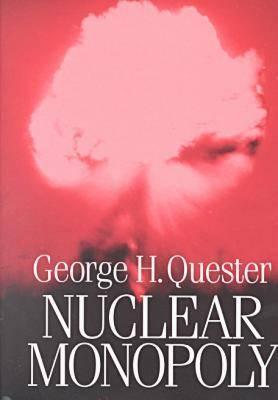
Nuclear Monopoly
Book Details
Delivery Location
Delivery fee: Select location
Throughout the decades of the Cold War, people all around the world lived in fear of thermonuclear war. To assuage that fear theorists of deterrence explained over and over again that both sides had to be able to retaliate with "mutual assured destruction," to keep nuclear weapons from being used. Yet this "basic fact" of nuclear deterrence begs the question: What deterred the United States from a preemptive strike before 1949 when Joseph Stalin''s Soviet Union had not yet acquired nuclear weapons of its own? In Nuclear Monopoly George Quester sets forth the case for preventive war using rudimentary atomic weapons to avoid the possibility of a future war in which both sides would have used hydrogen bombs.
Quester demonstrates that the notion of mutual assured destruction was rooted in the questionable assumption that assured destruction must be mutual and that the United States "of course" would never consider preventive war. He explores the logic of these assumptions against the historical circumstances of the years 1945-1949 and the thinking of influential personalities and decision-makers that determined U.S. nuclear policy. In 1945 the United States was able to inflict nuclear destruction and had no fear of retaliation. Arguably the United States could have used that advantage to extract major political concessions from the Soviet Union, including surrender, disarmament, and democratization. At the same time it might have prevented the proliferation and development of nuclear weapons. Against this view Quester analyzes a range of prevailing views from practical and procedural considerations. These range from the shortage of bombs and other resources, ineffectiveness of bombing, Soviet resistance, and the vulnerability of Western Europe, to larger questions of American morality: absence of a casus belli, civilian casualties, and concern about untrammeled arrogance of power.
With dissolution of the Soviet Union and the proliferation of nuclear weapons among small powers and rogue states, the failure to head off Soviet nuclear capacity takes on greater historical weight. The options of the next century will never be what they were from 1945-1949, but this study of the military and strategic decision-making provides important insights for future conflicts. Nuclear Monopoly will be of interest to military historians, policymakers, and political scientists.
Get Nuclear Monopoly by George H. Quester at the best price and quality guaranteed only at Werezi Africa's largest book ecommerce store. The book was published by Taylor & Francis Inc and it has 234 pages.
Customers Who Bought This Also Bought

Black Wave
KSh 2,700.00

Siege
KSh 2,000.00

Extractive Capitalism
KSh 2,150.00
Strategy
KSh 4,350.00

Fourth Industrial Revolution
KSh 2,700.00

On China
KSh 3,400.00

Dead Aid
KSh 3,400.00
The Bottom Billion
KSh 2,500.00

Leadership
KSh 2,700.00
How to Win a Trade War
KSh 3,050.00

Understanding Global Conflict and Cooperation: An Introduction to Theory and History
KSh 14,000.00
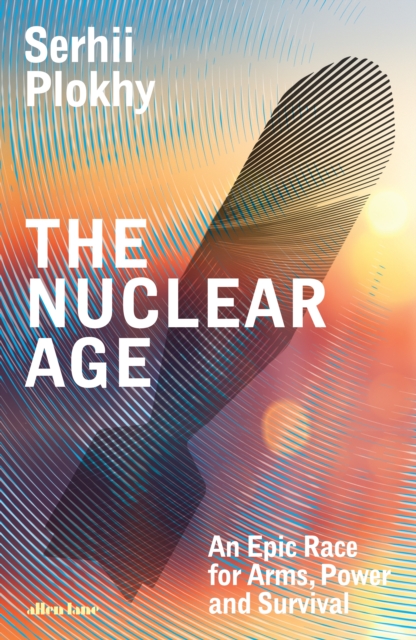
Nuclear Age
KSh 5,400.00
More by George H. Quester
Before and After the Cold War
KSh 22,500.00
Before and After the Cold War
KSh 7,450.00

Deterrence Before Hiroshima
KSh 8,450.00
Deterrence Before Hiroshima
KSh 30,950.00
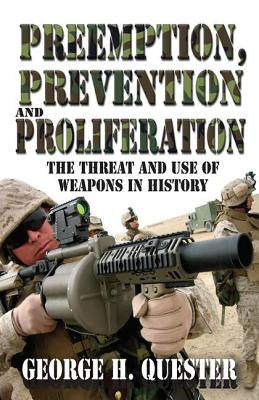
Preemption, Prevention and Proliferation
KSh 30,950.00
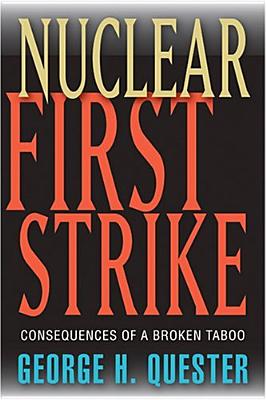
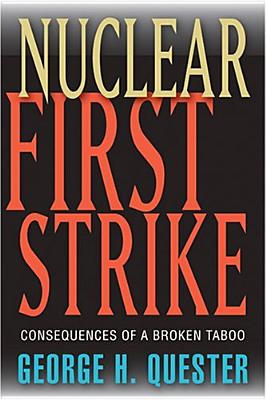
Nuclear First Strike
KSh 4,300.00
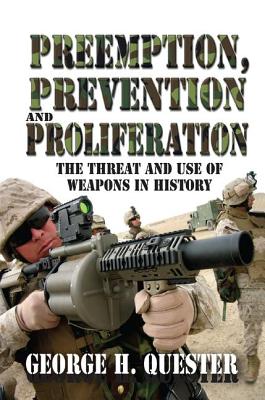
Preemption, Prevention and Proliferation
KSh 9,200.00
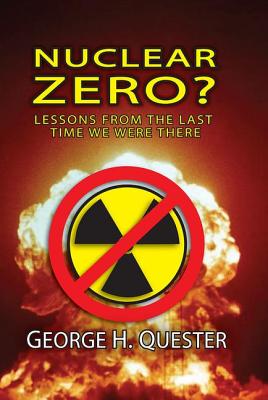
Nuclear Zero?
KSh 30,950.00
Nuclear First Strike
KSh 8,750.00
American Security in an Interdependent World
KSh 7,550.00
