
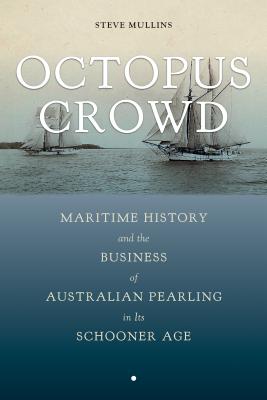
Octopus Crowd : Maritime History and the Business of Australian Pearling in Its Schooner Age
Book Details
Format
Hardback
Book Series
Maritime Currents: History and Archaeology
ISBN-10
0817320245
ISBN-13
9780817320249
Publisher
The University of Alabama Press
Imprint
The University of Alabama Press
Country of Manufacture
US
Country of Publication
GB
Publication Date
Aug 13th, 2019
Print length
296 Pages
Weight
666 grams
Dimensions
23.70 x 16.40 x 3.20 cms
Product Classification:
Australasian & Pacific historyMaritime historyAustralasian and Pacific historyMaritime history
KSh 8,300.00
Temporarily out of stock, due soon
0 in stock
Delivery Location
Delivery fee: Select location
Secure
Quality
Fast
The first book-length study of schooner-based pearling, this book explores the floating station system and the men who developed and employed it. Steve Mullins focuses on the Clark Combination, a syndicate led by James Clark, Australia's most influential pearler.
A detailed study of the origins and demise of schooner-based pearling in Australia.
For most of its history, Australian pearling was a shore-based activity. But from the mid-1880s until the World War I era, the industry was dominated by highly mobile, heavily capitalized, schooner-based fleets of pearling luggers, known as floating stations, that exploited Australia''s northern continental shelf and the nearby waters of the Netherlands Indies. Octopus Crowd:Maritime History and the Business of Australian Pearling in Its Schooner Age is the first book-length study of schooner-based pearling and explores the floating station system and the men who developed and employed it.
Steve Mullins focuses on the Clark Combination, a syndicate led by James Clark, Australia''s most influential pearler. The combination honed the floating station system to the point where it was accused of exhausting pearling grounds, elbowing out small-time operators, strangling the economies of pearling ports, and bringing the industry to the brink of disaster. Combination partners were vilified as monopolists—they were referred to as an ""octopus crowd""—and their schooners were stigmatized as hell ships and floating sweatshops.
Schooner-based floating stations crossed maritime frontiers with impunity, testing colonial and national territorial jurisdictions. The Clark Combination passed through four fisheries management regimes, triggering significant change and causing governments to alter laws and extend maritime boundaries. It drew labor from ports across the Asia-Pacific, and its product competed in a volatile world market. Octopus Crowd takes all these factors into account to explain Australian pearling during its schooner age. It argues that the demise of the floating station system was not caused by resource depletion, as was often predicted, but by ideology and Australia''s shifting sociopolitical landscape.
For most of its history, Australian pearling was a shore-based activity. But from the mid-1880s until the World War I era, the industry was dominated by highly mobile, heavily capitalized, schooner-based fleets of pearling luggers, known as floating stations, that exploited Australia''s northern continental shelf and the nearby waters of the Netherlands Indies. Octopus Crowd:Maritime History and the Business of Australian Pearling in Its Schooner Age is the first book-length study of schooner-based pearling and explores the floating station system and the men who developed and employed it.
Steve Mullins focuses on the Clark Combination, a syndicate led by James Clark, Australia''s most influential pearler. The combination honed the floating station system to the point where it was accused of exhausting pearling grounds, elbowing out small-time operators, strangling the economies of pearling ports, and bringing the industry to the brink of disaster. Combination partners were vilified as monopolists—they were referred to as an ""octopus crowd""—and their schooners were stigmatized as hell ships and floating sweatshops.
Schooner-based floating stations crossed maritime frontiers with impunity, testing colonial and national territorial jurisdictions. The Clark Combination passed through four fisheries management regimes, triggering significant change and causing governments to alter laws and extend maritime boundaries. It drew labor from ports across the Asia-Pacific, and its product competed in a volatile world market. Octopus Crowd takes all these factors into account to explain Australian pearling during its schooner age. It argues that the demise of the floating station system was not caused by resource depletion, as was often predicted, but by ideology and Australia''s shifting sociopolitical landscape.
Get Octopus Crowd by Stephen Mullins at the best price and quality guaranteed only at Werezi Africa's largest book ecommerce store. The book was published by The University of Alabama Press and it has 296 pages.
Customers Who Bought This Also Bought

Thicker Than Water
KSh 2,000.00

Transnational History in China
KSh 20,150.00

Joh for Canberra
KSh 3,850.00

The French at Akaroa
KSh 8,250.00

Forgetting Aborigines
KSh 4,000.00

Aloha Betrayed
KSh 3,800.00

Air War in the Falklands 1982
KSh 3,050.00

Indigenous Rights and Colonial Subjecthood
KSh 17,100.00

Pride in Defence – The Australian Military and LGBTI Service since 1945
KSh 4,150.00

Rag Tag Fleet
KSh 3,100.00
The British Colonization of New Zealand
KSh 8,250.00

Daniel Boyd
KSh 13,400.00
