
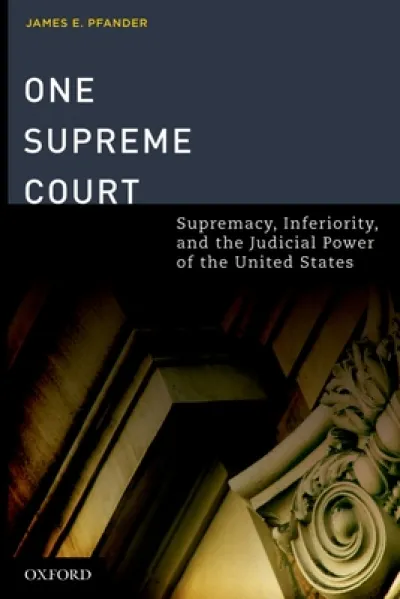
One Supreme Court : Supremacy, Inferiority, and the Judicial Department of the United States
Book Details
Format
Hardback or Cased Book
ISBN-10
0195340337
ISBN-13
9780195340334
Publisher
Oxford University Press Inc
Imprint
Oxford University Press Inc
Country of Manufacture
US
Country of Publication
GB
Publication Date
Jun 4th, 2009
Print length
328 Pages
Weight
615 grams
Dimensions
15.50 x 23.60 x 3.10 cms
Product Classification:
Courts & procedure
Ksh 21,400.00
Manufactured on Demand
0 in stock
Delivery Location
Delivery fee: Select location
Secure
Quality
Fast
Despite over two hundred years of experience with constitutional government, much remains unclear about the power of the political branches to curtail or re-define the judicial power of the United States. Uncertainty persists about the basis on which state courts and federal agencies may hear federal claims and the degree to which federal courts must review their decisions. Scholars approach these questions from a range of vantage points and have arrived at widely varying conclusions about the relationship between congressional and judicial power. Deploying familiar forms of legal analysis, and relying upon a new account of the Court's supremacy in relation to lower courts and tribunals, James Pfander advances a departmental conception of the judiciary. He argues that Congress can enlist the state courts, lower federal courts, and administrative agencies to hear federal claims in the first instance, but all of these tribunals must operate within a hierarchical framework over which the "one supreme Court" identified in the Constitution exercises ultimate supervisory authority. In offering the first general account of the Court as department head, Pfander takes up such important debates in the federal courts' literature as Congress's power to strip the federal courts of jurisdiction to review state court decisions, its authority to assign decision-making authority to state courts and non-Article III tribunals, its control over the doctrine of vertical stare decisis, and its ability to craft rules of practice for the federal system.
Despite over two hundred years of experience with constitutional government, much remains unclear about the power of the political branches to curtail or re-define the judicial power of the United States. Uncertainty persists about the basis on which state courts and federal agencies may hear federal claims and the degree to which federal courts must review their decisions. Scholars approach these questions from a range of vantage points and have arrived at widely varying conclusions about the relationship between congressional and judicial power. Deploying familiar forms of legal analysis, and relying upon a new account of the Court''s supremacy in relation to lower courts and tribunals, James Pfander advances a departmental conception of the judiciary. He argues that Congress can enlist the state courts, lower federal courts, and administrative agencies to hear federal claims in the first instance, but all of these tribunals must operate within a hierarchical framework over which the "one supreme Court" identified in the Constitution exercises ultimate supervisory authority. In offering the first general account of the Court as department head, Pfander takes up such important debates in the federal courts'' literature as Congress''s power to strip the federal courts of jurisdiction to review state court decisions, its authority to assign decision-making authority to state courts and non-Article III tribunals, its control over the doctrine of vertical stare decisis, and its ability to craft rules of practice for the federal system.
Get One Supreme Court by at the best price and quality guaranteed only at Werezi Africa's largest book ecommerce store. The book was published by Oxford University Press Inc and it has pages.

