
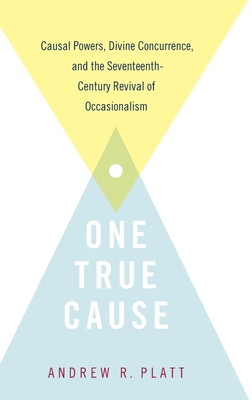
One True Cause : Causal Powers, Divine Concurrence, and the Seventeenth-Century Revival of Occasionalism
Book Details
Format
Hardback
ISBN-10
0190941790
ISBN-13
9780190941796
Publisher
Oxford University Press Inc
Imprint
Oxford University Press Inc
Country of Manufacture
US
Country of Publication
GB
Publication Date
Sep 30th, 2020
Print length
396 Pages
Weight
696 grams
Dimensions
16.50 x 24.20 x 3.70 cms
Product Classification:
Western philosophy: c 1600 to c 1900Philosophy: metaphysics & ontology
KSh 15,100.00
Currently unavailable
0 in stock
Delivery Location
Delivery fee: Select location
Secure
Quality
Fast
Starting in the 1660s, followers of the philosopher Descartes argued for what has come to be known as "occasionalism." In its most extreme form, occasionalism is the doctrine that God directly causes everything that happens in the world, and no other being is a true cause of any effect. The views of Cartesian occasionalists were once largely dismissed by English-speaking philosophers. But since the 1970s, a growing body of secondary literature has highlighted the historical significance, and philosophical interest, of their views. This study expands on recent scholarship to provide the first comprehensive account of occasionalism in the seventeenth century.
Occasionalism is the thesis that God alone is the true cause of everything that happens in the world, and created substances are merely "occasional causes." This doctrine was originally developed in medieval Islamic theology, and was widely rejected in the works of Christian authors in medieval Europe. Yet despite its heterodoxy, occasionalism was revived in the 1660s by followers of the philosophy of René Descartes, perhaps the most famous among them the French philosopher Nicolas Malebranche, who popularized this doctrine. What led Cartesian thinkers to adopt occasionalism? Since the 1970s has there been a growing body of literature on Malebranche and the movement he engendered. There is also a new and growing body of work on the Cartesian occasionalists before Malebranche--including Arnold Geulincx, Geraud de Cordemoy, and Louis de la Forge. But to date there has not been a systematic, book-length study of the reasoning that led Cartesian thinkers to adopt occasionalism, and the relationship of their arguments to Descartes'' own views. This book expands on recent scholarship to provide the first comprehensive account of seventeenth century occasionalism. Part I contrasts occasionalism with a theory of divine providence developed by Thomas Aquinas, in response to medieval occasionalists; it shows that Descartes'' philosophy is compatible with Aquinas'' theory, on which God "concurs" in all the actions of created beings. Part II reconstructs the arguments of Cartesians--such as Cordemoy and La Forge--who used Cartesian physics to argue for occasionalism. Finally, the book shows how Malebranche''s case for occasionalism combines philosophical theology with Cartesian metaphysics and mechanistic science.
Get One True Cause by Andrew R. Platt at the best price and quality guaranteed only at Werezi Africa's largest book ecommerce store. The book was published by Oxford University Press Inc and it has 396 pages.
Customers Who Bought This Also Bought

Why I Am so Clever
KSh 700.00

A Treatise of Human Nature
KSh 2,700.00
On the Genealogy of Morals
KSh 2,000.00
Critique of Pure Reason
KSh 3,400.00
Beyond Good and Evil
KSh 2,000.00
Either/Or
KSh 2,700.00

Great Ideas Fear and Trembling
KSh 1,450.00
Outlines of the Philosophy of Right
KSh 2,500.00
Critique of Judgement
KSh 2,700.00

Prolegomena to Any Future Metaphysics
KSh 2,700.00

Kant – A Revolution in Thinking
KSh 4,500.00
An Answer to the Question: ''What is Enlightenment?''
KSh 1,450.00
