
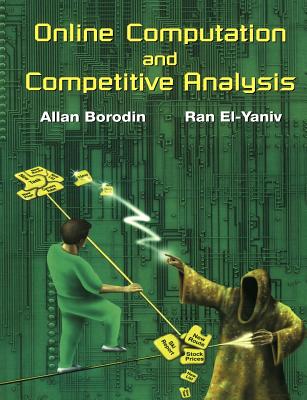
Online Computation and Competitive Analysis
Book Details
Format
Paperback / softback
ISBN-10
0521619467
ISBN-13
9780521619462
Publisher
Cambridge University Press
Imprint
Cambridge University Press
Country of Manufacture
GB
Country of Publication
GB
Publication Date
Feb 17th, 2005
Print length
436 Pages
Weight
770 grams
Dimensions
24.60 x 18.80 x 2.20 cms
Product Classification:
Computer programming / software developmentComputer programming / software engineering
KSh 15,650.00
Currently unavailable
0 in stock
Delivery Location
Delivery fee: Select location
Secure
Quality
Fast
Contains theoretical foundations, applications, and examples of competitive analysis for online algorithms.
In online computation a computer algorithm must decide how to act on incoming items of information without any knowledge of future inputs. How should it route the next telephone call? Where in memory should it store a just-closed record? This book provides an in-depth presentation of competitive analysis, an attractive framework within which such problems can be analyzed and solved. In this framework, the quality of an algorithm is measured relative to the best possible performance of an algorithm that has complete knowledge of the future. This methodology for the analysis of online decision making has become a standard approach in computer science. Starting with the basic definitions of the competitive analysis model, the authors present most of the essential techniques through various examples, some of which are among the central problems of the field, such as list accessing, paging in a virtual memory system, routing in a communication network, metrical task systems, k-server systems, load balancing, search, and portfolio selection. The book also shows how competitive analysis relates to more classical subjects such as game theory and decision theory. This is an important text and reference for researchers and graduate students in theoretical computer science and in operations research.
Get Online Computation and Competitive Analysis by Allan Borodin, Ran El-Yaniv at the best price and quality guaranteed only at Werezi Africa's largest book ecommerce store. The book was published by Cambridge University Press and it has 436 pages.
Customers Who Bought This Also Bought
Python Crash Course, 3rd Edition
KSh 8,650.00

Managing Construction Technology
KSh 11,700.00

Machine Learning with Python
KSh 14,750.00

Programming Language Pragmatics
KSh 14,650.00
Constraint Processing
KSh 13,850.00
Programming from the Ground Up
KSh 5,150.00
Arduino Internals
KSh 9,900.00
Palm Programming in Basic
KSh 5,150.00
Spark – The Definitive Guide
KSh 10,100.00
COBOL and Visual Basic on .NET
KSh 9,000.00
Android Application Development All–in–One For Dummies, 3rd Edition
KSh 5,950.00

Choose your WoW - Second Edition (FRENCH)
KSh 3,450.00

