
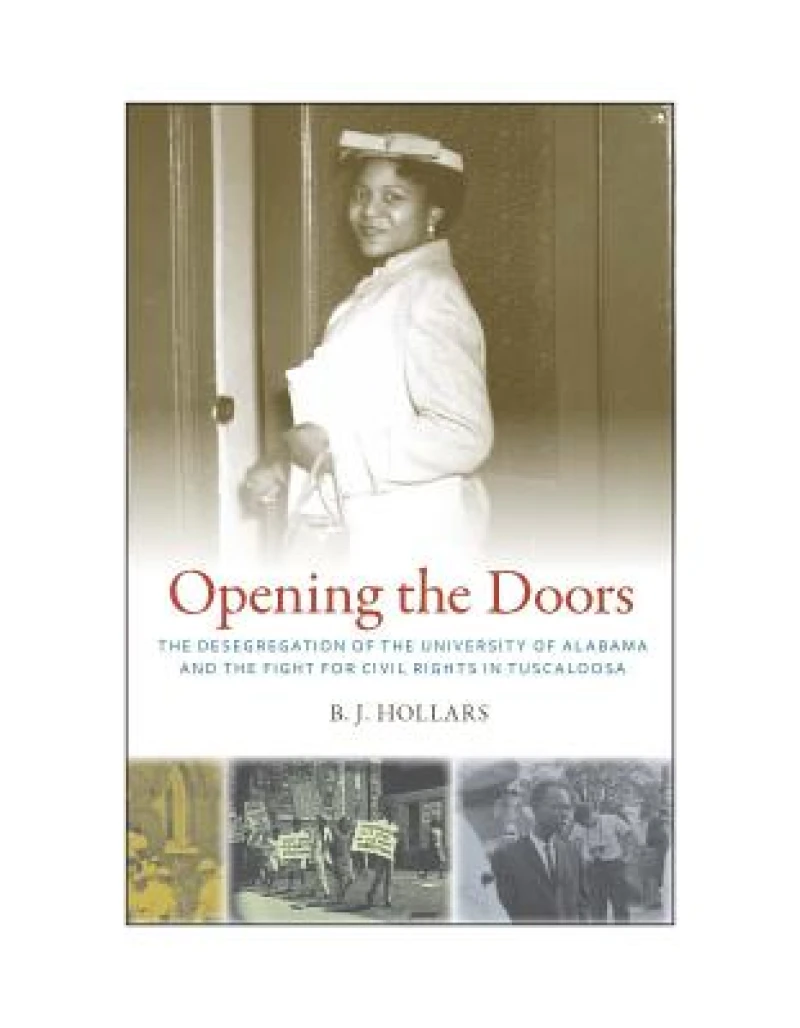
Opening the Doors : The Desegregation of the University of Alabama and the Fight for Civil Rights in Tuscaloosa
Book Details
Format
Hardback or Cased Book
ISBN-10
0817317929
ISBN-13
9780817317928
Publisher
The University of Alabama Press
Imprint
The University of Alabama Press
Country of Manufacture
US
Country of Publication
GB
Publication Date
Mar 14th, 2013
Print length
304 Pages
Weight
630 grams
Dimensions
16.40 x 23.70 x 2.80 cms
Product Classification:
History of the AmericasHistory of the Americas
Ksh 5,600.00
Publisher Out of Stock
0 in stock
Delivery Location
Delivery fee: Select location
Secure
Quality
Fast
Provides a wide-ranging account of the University of Alabama’s 1956 and 1963 desegregation attempts, as well as the little-known story of Tuscaloosa, Alabama’s, own civil rights movement. B. J. Hollars focuses on Tuscaloosa’s purposeful divide between ‘town’ and ‘gown’, providing a new contextual framework for this landmark period in civil rights history.
Opening the Doors is a wide-ranging account of the University of Alabama’s 1956 and 1963 desegregation attempts, as well as the little-known story of Tuscaloosa, Alabama’s, own civil rights movement.
Whereas E. Culpepper Clark’s The Schoolhouse Door remains the standard history of the University of Alabama’s desegregation, in Opening the Doors B. J. Hollars focuses on Tuscaloosa’s purposeful divide between “town” and “gown,” providing a new contextual framework for this landmark period in civil rights history.
The image of George Wallace’s stand in the schoolhouse door has long burned in American consciousness; however, just as interesting are the circumstances that led him there in the first place, a process that proved successful due to the concerted efforts of dedicated student leaders, a progressive university president, a steadfast administration, and secret negotiations between the U.S. Justice Department, the White House, and Alabama’s stubborn governor.
In the months directly following Governor Wallace’s infamous stand, Tuscaloosa became home to a leader of a very different kind: twenty-eight-year-old African American reverend T. Y. Rogers, an up-and-comer in the civil rights movement, as well as the protégé of Martin Luther King Jr. After taking a post at Tuscaloosa’s First African Baptist Church, Rogers began laying the groundwork for the city’s own civil rights movement. In the summer of 1964, the struggle for equality in Tuscaloosa resulted in the integration of the city’s public facilities, a march on the county courthouse, a bloody battle between police and protesters, confrontations with the Grand Wizard of the Ku Klux Klan, a bus boycott, and the near-accidental-lynching of movie star Jack Palance.
Relying heavily on new firsthand accounts and personal interviews, newspapers, previously classified documents, and archival research, Hollars’s in-depth reporting reveals the courage and conviction of a town, its university, and the people who call it home.
Whereas E. Culpepper Clark’s The Schoolhouse Door remains the standard history of the University of Alabama’s desegregation, in Opening the Doors B. J. Hollars focuses on Tuscaloosa’s purposeful divide between “town” and “gown,” providing a new contextual framework for this landmark period in civil rights history.
The image of George Wallace’s stand in the schoolhouse door has long burned in American consciousness; however, just as interesting are the circumstances that led him there in the first place, a process that proved successful due to the concerted efforts of dedicated student leaders, a progressive university president, a steadfast administration, and secret negotiations between the U.S. Justice Department, the White House, and Alabama’s stubborn governor.
In the months directly following Governor Wallace’s infamous stand, Tuscaloosa became home to a leader of a very different kind: twenty-eight-year-old African American reverend T. Y. Rogers, an up-and-comer in the civil rights movement, as well as the protégé of Martin Luther King Jr. After taking a post at Tuscaloosa’s First African Baptist Church, Rogers began laying the groundwork for the city’s own civil rights movement. In the summer of 1964, the struggle for equality in Tuscaloosa resulted in the integration of the city’s public facilities, a march on the county courthouse, a bloody battle between police and protesters, confrontations with the Grand Wizard of the Ku Klux Klan, a bus boycott, and the near-accidental-lynching of movie star Jack Palance.
Relying heavily on new firsthand accounts and personal interviews, newspapers, previously classified documents, and archival research, Hollars’s in-depth reporting reveals the courage and conviction of a town, its university, and the people who call it home.
Get Opening the Doors by at the best price and quality guaranteed only at Werezi Africa's largest book ecommerce store. The book was published by The University of Alabama Press and it has pages.

