
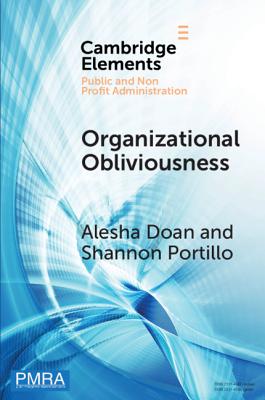
Organizational Obliviousness : Entrenched Resistance to Gender Integration in the Military
Book Details
Format
Paperback / softback
Book Series
Elements in Public and Nonprofit Administration
ISBN-10
1108465439
ISBN-13
9781108465434
Publisher
Cambridge University Press
Imprint
Cambridge University Press
Country of Manufacture
GB
Country of Publication
GB
Publication Date
Jun 13th, 2019
Print length
78 Pages
Weight
132 grams
Dimensions
15.50 x 22.80 x 0.70 cms
KSh 3,250.00
Currently unavailable
0 in stock
Delivery Location
Delivery fee: Select location
Secure
Quality
Fast
Explores efforts to integrate women into combat forces in the military. Investigates how resistance to equity becomes entrenched. Traces the ways that organizational obliviousness shapes individuals, culture, and institutional practices throughout an organization. Based on focus groups and surveys with members of Special Operations.
Exploring efforts to integrate women into combat forces in the military, we investigate how resistance to equity becomes entrenched, ultimately excluding women from being full participants in the workplace. Based on focus groups and surveys with members of Special Operations, we found most of the resistance is rooted in traditional gender stereotypes that are often bolstered through organizational policies and practices. The subtlety of these practices often renders them invisible. We refer to this invisibility as organizational obliviousness. Obliviousness exists at the individual level, it becomes reinforced at the cultural level, and, in turn, cultural practices are entrenched institutionally by policies. Organizational obliviousness may not be malicious or done to actively exclude or harm, but the end result is that it does both. Throughout this Element we trace the ways that organizational obliviousness shapes individuals, culture, and institutional practices throughout the organization.
Get Organizational Obliviousness by Alesha Doan, Shannon Portillo at the best price and quality guaranteed only at Werezi Africa's largest book ecommerce store. The book was published by Cambridge University Press and it has 78 pages.
Customers Who Bought This Also Bought

American Beast
KSh 2,700.00

In Defense of Politics in Public Administration
KSh 3,450.00

The New Global Economic Order
KSh 7,200.00

The Brexit Effect, 2016–2026
KSh 3,050.00

The Moynihan Report Revisited:
KSh 12,100.00

Building Service-Oriented Government
KSh 5,050.00

The Moynihan Report Revisited:
KSh 12,050.00

Saving the Georgia Coast
KSh 4,650.00

Migration Crises and the Structure of International Cooperation
KSh 17,000.00

Keeping the Chattahoochee
KSh 5,500.00

Night Rules
KSh 30,950.00

Partners in Gatekeeping
KSh 26,700.00
