Cart 0
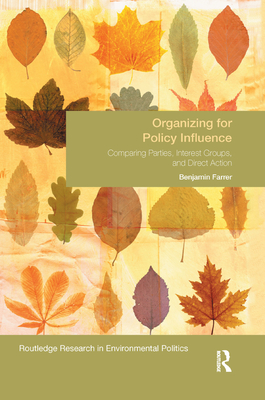
Organizing for Policy Influence
Click to zoom

Share this book

Organizing for Policy Influence : Comparing Parties, Interest Groups, and Direct Action

Book Details

Format Hardback or Cased Book
ISBN-10 1138724815
ISBN-13 9781138724815
Publisher Taylor & Francis Ltd
Imprint Routledge
Country of Manufacture GB
Country of Publication GB
Publication Date Aug 15th, 2017
Print length 260 Pages
Weight 516 grams
Dimensions 15.80 x 23.50 x 2.20 cms
Ksh 27,900.00
Werezi Extended Catalogue Delivery in 28 days

Delivery Location

Delivery fee: Select location

Delivery in 28 days

Secure
Quality
Fast
Benjamin Farrer examines how activists can influence policy outcomes, even when they are outnumbered or relegated to a niche in democratic society

In this book, Benjamin Farrer explains how activists can influence the policies they care about, even when they are outnumbered and their issues are ignored. The solution lies in a surprising place: organizational choice. Different types of organizations will be more influential under particular democratic institutions. If they choose the optimal type of organization - given their institutional context - then even minority groups can be influential. Environmentalists are a key example of how small groups can sometimes punch above their weight. Environmentalists in different countries have made different organizational choices. These choices explain whether or not they succeeded in influencing policy. In the empirical chapters that follow, Farrer shows that environmentalists can sometimes be more influential if they form interest groups, but under other institutions, political parties are the optimal organizational choice. Although interest groups are often easier to create, national institutions can sometimes insulate mainstream politicians from niche interest groups. When institutions deny access to interest groups, activists are forced to send the stronger signal of party entry. 

Using a variety of methods, including a formal model, an experiment, and a wealth of empirical data from a variety of settings, Farrer proves that this theory of organizational choice adds to our understanding of several crucial phenomena. First, it helps explain patterns of political participation, by showing the importance of instrumental, rather than purely expressive, motivations for activism. Second, it provides an important modification to Duverger’s (1954) law, by showing that new party entry is a function not only of electoral rules but also of the rules that govern interest groups. Third, it extends research on the role of institutions in determining policy outputs, by showing that policy outcomes are a function of the interaction between organizational choices and institutional context.


Get Organizing for Policy Influence by at the best price and quality guaranteed only at Werezi Africa's largest book ecommerce store. The book was published by Taylor & Francis Ltd and it has pages.

Mind, Body, & Spirit

Price

Ksh 27,900.00

Shopping Cart

Africa largest book store

Sub Total:
Ebooks

Digital Library
Coming Soon

Our digital collection is currently being curated to ensure the best possible reading experience on Werezi. We'll be launching our Ebooks platform shortly.