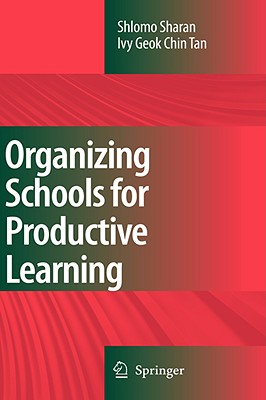
Organizing Schools for Productive Learning
1st ed. Softcover of orig. ed. 2008
Book Details
Format
Paperback / softback
ISBN-10
9048178665
ISBN-13
9789048178667
Edition
1st ed. Softcover of orig. ed. 2008
Publisher
Springer
Imprint
Springer
Country of Manufacture
NL
Country of Publication
GB
Publication Date
Oct 19th, 2010
Print length
112 Pages
KSh 8,100.00
Currently unavailable
0 in stock
Delivery Location
Delivery fee: Select location
Secure
Quality
Fast
This book offers an alternative approach to secondary school organization. In line with the definition formulated by John Dewey's philosophy of education, the book shows how to respond more successfully to the requirements of today's information age.
LIST OF TABLES LIST OF FIGURES Introduction Students are bored in school Why the boredom? The road to productive learning in school Chapter 1 Two Models of School Structure Structural change: necessary but not sufficient Organizational regularities in school 1. The one-by-one formula The ''one-by-one'' formula and the hierarchical nature of bureaucracy A hard-nosed view of the one-by-one concept 2. The greater than one formula A policy of instructional coherence The discipline oriented organization of schools Human organization is contrived What structure cannot do for teachers School organization and teaching practices: a summary of our goals Chapter 2 The School as a Community; the School in the Community Part 1: The school as a community School organization and community Communities and other enterprises The goals of the school as a community Community and academic disciplines Qualities of leadership Part 2: The school in the community The community as a site for learning Chapter 3 Student Engagement in Learning A cognitive-affective concept Engagement and the learning environment Engagement and students'' conceptions of learning Meaning and student autonomy Chapter 4 Class Size and School Size What is a large class? Teaching methods omitted from studies of class size Does class size inhibit innovation? School size Chapter 5 The Integrated Curriculum The fusion of academic disciplines The problem of relevance The problem of integration Chapter 6 Duration of Class Sessions and the Problem of Teaching Method The anticipated demise of the 50-minute hour Alternative teachingmethods and the 50-minute hour More alternative schedules Extensive and intensive study projects How schedule reform affects teaching: some research Teachers'' evaluations Results regarding students Some conclusions Chapter 7 Student Assessment Assessment as testing Alternative assessment Summative and formative assessment More alternative approaches to assessment Chapter 8 A Systems Approach to Organization and Instruction in Schools Systems integrate, bureaucracies separate A system is not a collection Classrooms as social systems Can schools adopt new principles of organization? References
Get Organizing Schools for Productive Learning by Ivy Geok Chin Tan, Shlomo Sharan at the best price and quality guaranteed only at Werezi Africa's largest book ecommerce store. The book was published by Springer and it has 112 pages.
Customers Who Bought This Also Bought
Make It Stick – The Science of Successful Learning
KSh 5,200.00

The Perks of Being a Bookworm
KSh 4,500.00
Helping Children Succeed
KSh 3,050.00

Secondary Traumatic Stress in Teaching
KSh 5,750.00

Learning Without Lessons
KSh 13,100.00
Teaching with the Brain in Mind
KSh 5,150.00

Teaching with the HEART in Mind
KSh 3,700.00

Teaching in the Wobble
KSh 5,750.00
Enhancing Teaching and Learning through Assessment
KSh 32,400.00
Authority and the Teacher
KSh 5,200.00

School Didactics And Learning
KSh 30,950.00

Text Messaging and Literacy - The Evidence
KSh 30,950.00