
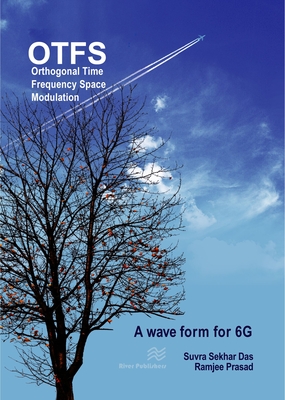
Orthogonal Time Frequency Space Modulation : OTFS a waveform for 6G
Book Details
Delivery Location
Delivery fee: Select location
Over the last few decades wireless communications, especially Mobile Communication Technology, has evolved by leaps and bounds. The mobile communication industry has named the different major changes as generations namely 1G, 2G,..5G. We are presently looking at deployment of 5G technologies. The work for 6G has already started.
This book is focused on the waveform design of 6G. It presents a discourse on a potential waveform for 6G namely Orthogonal Time Frequency Space (OTFS) modulation. OTFS has a distinct feature when compared to earlier generation waveforms such that information bearing signal is placed in the delay Doppler domain as opposed to the usual placement of such signals in the time-frequency domain. This unique feature of OTFS enables it to overcome several disadvantages of a very popular and highly successful waveform namely Orthogonal Frequency Division Multiplexing (OFDM). OTFS is known to be more resilient to frequency offset and Doppler which is one of the key drawbacks of OFDM. With this feature, OTFS, can support higher mobility as well as higher frequency bands of operation which is also one of the key requirements of the next generation wireless communication technologies. The implementation complexity of OTFS remains comparable to that of OFDM. It is found that OTFS provides significant SNR advantage, higher resilience, lower PAPR, lower out of band signal leakage and higher multi-user spectral efficiency than that of OFDM. This book addresses
• Fundamental signal model of OTFS.
• Receiver design for OTFS
• Channel estimation in OTFS
• Multiple Access through non-orthogonal multiple access (NOMA-OTFS)
The contents of the books are primarily outcome of the research work done at the G. S. Sanyal School of Telecommunications, Indian Institute of Technology Kharagpur, Kharagpur, India.
Orthogonal Time Frequency Space Modulation : A waveform for 6G is ideal for personnel the wireless communication industry as well as academic staff and master/research students in electrical engineering with a specialization in wireless communications.
Get Orthogonal Time Frequency Space Modulation by Ramjee Prasad, Suvra Sekhar Das at the best price and quality guaranteed only at Werezi Africa's largest book ecommerce store. The book was published by River Publishers and it has 236 pages.
Customers Who Bought This Also Bought

Ultra-Wideband Positioning Systems
KSh 12,050.00

Integrating Edge Intelligence and Blockchain
KSh 8,100.00
Ultra-wideband Positioning Systems
KSh 20,350.00

8th EAI International Conference on Computer Science and Engineering in Health Services
KSh 39,600.00

Advances in Intelligent Computing and Communication Technology
KSh 26,300.00

Subspace Methods for System Identification
KSh 23,400.00

The Internet and Telecommunications Policy
KSh 18,700.00
Cryptographic Engineering
KSh 39,600.00

Iterative Learning Stabilization and Fault-Tolerant Control for Batch Processes
KSh 16,200.00
Schrödinger’s Web
KSh 37,800.00
Trends in Communication, Cloud, and Big Data
KSh 23,400.00

Electromagnetic Optics of Thin-Film Coatings
KSh 13,550.00
More by Ramjee Prasad, Suvra Sekhar Das

WiMAX Networks
KSh 32,400.00

Cyber Security
KSh 23,400.00

VoIP Technology
KSh 19,800.00

Context-Aware Communication and Computing: Applications for Smart Environment
KSh 16,200.00

WiMAX Networks
KSh 32,400.00

6G: The Road to the Future Wireless Technologies 2030
KSh 7,750.00

Ofdm Based Relay Systems for Future Wireless Communications
KSh 7,800.00

Adaptive PHY-MAC Design for Broadband Wireless Systems
KSh 10,000.00

Evolution of Air Interface Towards 5G
KSh 16,550.00

Cyber Security
KSh 23,400.00

Orthogonal Time Frequency Space Modulation
KSh 7,850.00
5g
KSh 14,750.00
More in This Genre
Ultra-Wideband Positioning Systems
KSh 12,050.00
Integrating Edge Intelligence and Blockchain
KSh 8,100.00
Ultra-wideband Positioning Systems
KSh 20,350.00
8th EAI International Conference on Computer Science and Engineering in Health Services
KSh 39,600.00
Advances in Intelligent Computing and Communication Technology
KSh 26,300.00
Subspace Methods for System Identification
KSh 23,400.00
