
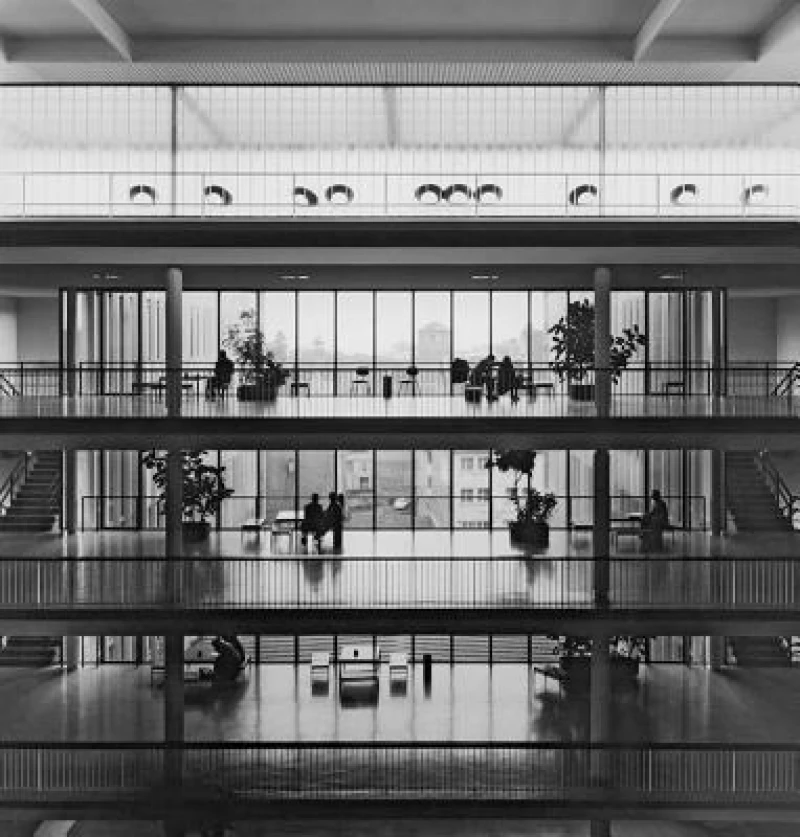
Otto Ernst Schweizer, Kollegienebaude II, Universitat Freiburg
Book Details
Format
Hardback or Cased Book
ISBN-10
3932565738
ISBN-13
9783932565731
Publisher
Edition Axel Menges
Imprint
Edition Axel Menges
Country of Manufacture
DE
Country of Publication
GB
Publication Date
Mar 1st, 2015
Print length
60 Pages
Weight
850 grams
Dimensions
31.30 x 29.20 x 1.40 cms
Product Classification:
Individual architects & architectural firmsPublic buildings: civic, commercial, industrial, etc
Ksh 5,200.00
Werezi Extended Catalogue
0 in stock
Delivery Location
Delivery fee: Select location
Secure
Quality
Fast
Aims to trigger wide public debates about the central issues within the 21st-century public challenge to architecture about how contemporary architecture should intervene in an existing urban environment with clear historical values, using the full potential inherent in modern society.
With the Kollegiengebäude II (college building II) of the University of Freiburg dedicated in 1961 the architect Otto Ernst Schweizer had achieved a masterpiece. Being built in the modern design idiom, it nevertheless took Freiburg’s tradition into account and gave a new quality of life to the university and the urban development of the inner city quarters. On the whole it was a significant stimulus to university construction. Thanks to the neutral expression of the building, its compact overall form and its »elastic structural system« (there is maximum flexibility in room layout without touching the bearing skeleton), and together with the laconically simple floor plan it became a prototype solution for smooth functioning. It is an open architecture, free of any suffocating pathos, with wide open spaces, human scale in size and proportions and in ideal accordance with academic freedom for research, instruction and learning.
Schweizer, born in 1890 and deceased in 1965, professor of urban construction at the Technische Hochschule Karlsruhe is one of the ground-breaking architects of the 20th century. In the late 1920s he gained international renognition and relevance with his buildings in Nuremburg, among them the stadium grounds and the Milchhof, as well as the Prater-Stadion in Vienna. During the 1930s, when he was not allowed to build, he studied fundamental questions of architecture and urbanism. After the Second World War he used his insights to make recommendations for the reconstruction of destroyed cities like Gießen, Karlsruhe, Mannheim or Stuttgart. In his last project, the Kollegiengebäude II we find the quintessence of a rich creative life, convincingly demonstrating Schweizer’s high demands on architectural form and function.
Schweizer, born in 1890 and deceased in 1965, professor of urban construction at the Technische Hochschule Karlsruhe is one of the ground-breaking architects of the 20th century. In the late 1920s he gained international renognition and relevance with his buildings in Nuremburg, among them the stadium grounds and the Milchhof, as well as the Prater-Stadion in Vienna. During the 1930s, when he was not allowed to build, he studied fundamental questions of architecture and urbanism. After the Second World War he used his insights to make recommendations for the reconstruction of destroyed cities like Gießen, Karlsruhe, Mannheim or Stuttgart. In his last project, the Kollegiengebäude II we find the quintessence of a rich creative life, convincingly demonstrating Schweizer’s high demands on architectural form and function.
Get Otto Ernst Schweizer, Kollegienebaude II, Universitat Freiburg by at the best price and quality guaranteed only at Werezi Africa's largest book ecommerce store. The book was published by Edition Axel Menges and it has pages.

