
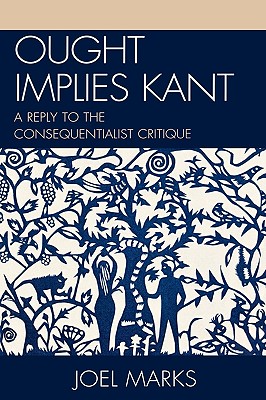
Ought Implies Kant : A Reply to the Consequentialist Critique
by
Joel Marks
Book Details
Format
Hardback
ISBN-10
0739128779
ISBN-13
9780739128770
Publisher
Bloomsbury Publishing Plc
Imprint
Lexington Books
Country of Manufacture
GB
Country of Publication
GB
Publication Date
Jan 16th, 2009
Print length
132 Pages
Weight
318 grams
Dimensions
23.80 x 16.30 x 1.40 cms
KSh 18,150.00
Currently unavailable
0 in stock
Delivery Location
Delivery fee: Select location
Secure
Quality
Fast
This book offers an unconventional defense of Kantian ethical theory as encompassing moral regard for nonhuman animals and, complementarily, an exhaustive rendition of a relatively neglected refutation of consequentialism as violating an essential meta-ethical condition of theoretical viability.
Ought Implies Kant offers an original defense of the ethical theory of Immanuel Kant, and develops an extension of that theory’s account of moral duty to include direct duties to nonhuman animals. The discussion centers on a critical examination of consequentialism, the view that the rightness or wrongness of an action is determined solely by its consequences. Kantianism, by contrast, claims that the core of ethics is to treat all persons—or, in Joel Marks’s view, all living beings—as ends-in-themselves. The consequentialist criterion would seem to permit, indeed require, violating the dignity of persons (not to mention the dignity of other animals) if this would result in a better outcome. This volume treats the consequentialist challenge to Kantian ethics in several novel ways. To begin with, the utilitarian version of consequentialism is delineated and defended by means of a conceptual device dubbed by the author as the Consequentialist Continuum. Marks then provides an exhaustive and definitive exposition of the relatively neglected Epistemic Objection to utilitarianism. While acknowledging the intuitive appeal of utilitarianism’s core conviction—that we should always do what is for the best—Marks argues that this is an impossible injunction to fulfill, or even to attempt to fulfill, because all of the relevant results of our actions can never be known. Kantianism is then introduced as a viable alternative account of our ethical obligations. Marks argues that Kantianism is well within the scope of normal human competence and conforms equally well to our ethical intuitions once the theory’s proper interpretation is appreciated. However, Kant’s own version must be extended to accommodate the rightful moral consideration we owe to nonhuman animals. Finally, Marks employs the notion of a Consequentialist Illusion to explain utilitarianism’s hold on our moral intuitions, while developing a form of Consequentialist Kantianism to address them. An original and penetrating examination of a central debate
Get Ought Implies Kant by Joel Marks at the best price and quality guaranteed only at Werezi Africa's largest book ecommerce store. The book was published by Bloomsbury Publishing Plc and it has 132 pages.
Customers Who Bought This Also Bought
Decolonizing Language and Other Revolutionary Ideas
KSh 2,350.00

How to Read a Book
KSh 2,000.00
Decolonizing Language and Other Revolutionary Ideas
KSh 3,600.00

Creative Act
KSh 3,250.00
Groundwork for the Metaphysics of Morals
KSh 2,000.00

Things in Nature Merely
KSh 2,000.00
Meditations – The Philosophy Classic
KSh 2,150.00

Great Ideas Social Contract
KSh 1,450.00
How to Be a Leader – An Ancient Guide to Wise Leadership
KSh 2,800.00
The Daily Laws
KSh 2,350.00

Three Critiques, 3-volume Set
KSh 14,000.00

Philosophical Dictionary
KSh 2,700.00
More by Joel Marks

Hard Atheism and the Ethics of Desire
KSh 13,500.00

Ethical Health
KSh 4,500.00

Hard Atheism and the Ethics of Desire
KSh 13,500.00
Ethics without Morals
KSh 10,100.00
Moral Moments
KSh 7,450.00
Reason and Ethics
KSh 30,950.00

Reason and Ethics
KSh 8,650.00

Ethical Health
KSh 10,100.00
Ethics Without Morals
KSh 33,850.00
