

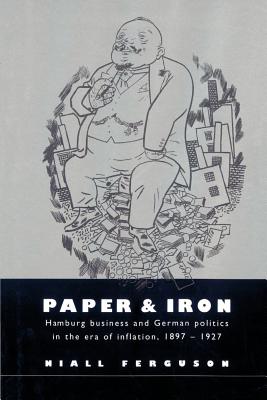
Paper and Iron : Hamburg Business and German Politics in the Era of Inflation, 1897–1927
Book Details
Format
Hardback
ISBN-10
0521470161
ISBN-13
9780521470162
Publisher
Cambridge University Press
Imprint
Cambridge University Press
Country of Manufacture
GB
Country of Publication
GB
Publication Date
Apr 27th, 1995
Print length
556 Pages
Weight
966 grams
Dimensions
16.20 x 23.70 x 3.80 cms
Product Classification:
20th century, c 1900 to c 1999Economic history
KSh 24,650.00
Currently unavailable
0 in stock
Delivery Location
Delivery fee: Select location
Secure
Quality
Fast
In this analysis of the German inflation of the early 1920s, Niall Ferguson argues that stabilising economic policies could have been adopted in 1920, had it not been for long-standing defects in Germany's political institutions.
Few economic events have had a more profound or enduring impact than the German hyperinflation of 1923, still remembered popularly as a root cause of Hitler's rise to power. Yet many historians have argued that inflationary policies were, on balance, advantageous to post-1918 Germany, both boosting growth and helping to reduce reparations. The scholarly consensus is that there was no viable alternative to inflation. In Paper and Iron Niall Ferguson takes a different view. He argues that inflation was indeed an economic and political disaster, and further that there were alternative economic policies which could have stabilised the German currency in 1920. To explain why these were not adopted he points to long-term defects in the political institutions of the Reich which went back as far as the 1890s and which persisted beyond 1918. The book therefore reveals the Wilhelmine origins of Weimar's failure, as well as casting light on the origins of the Third Reich.
Get Paper and Iron by Niall Ferguson at the best price and quality guaranteed only at Werezi Africa's largest book ecommerce store. The book was published by Cambridge University Press and it has 556 pages.
Customers Who Bought This Also Bought

Basic Laws of Human Stupidity
KSh 2,000.00
Economics Book
KSh 4,250.00
The Great Escape
KSh 2,900.00
Abundance
KSh 2,150.00
General Theory of Employment, Interest and Money
KSh 1,400.00
Guns, Germs and Steel
KSh 2,400.00
What Happened to Liberal Democracy?
KSh 3,050.00
Abundance
KSh 3,050.00

Autocracy, Inc
KSh 2,350.00

Autocracy, Inc
KSh 3,600.00

Capital in the Twenty–First Century
KSh 4,350.00
A Culture of Growth – The Origins of the Modern Economy
KSh 3,950.00
More by Niall Ferguson

Empire
KSh 2,700.00

Square and the Tower
KSh 3,050.00
Paper and Iron
KSh 9,600.00

The House of Rothschild
KSh 3,950.00

Does the 21st Century Belong to China?
KSh 2,000.00

Middle Parts of Fortune
KSh 2,000.00

Colossus
KSh 2,000.00

Pity of War
KSh 3,400.00

Virtual History
KSh 2,350.00

High Financier
KSh 3,950.00

Doom: The Politics of Catastrophe
KSh 2,350.00

Great Degeneration
KSh 2,000.00