
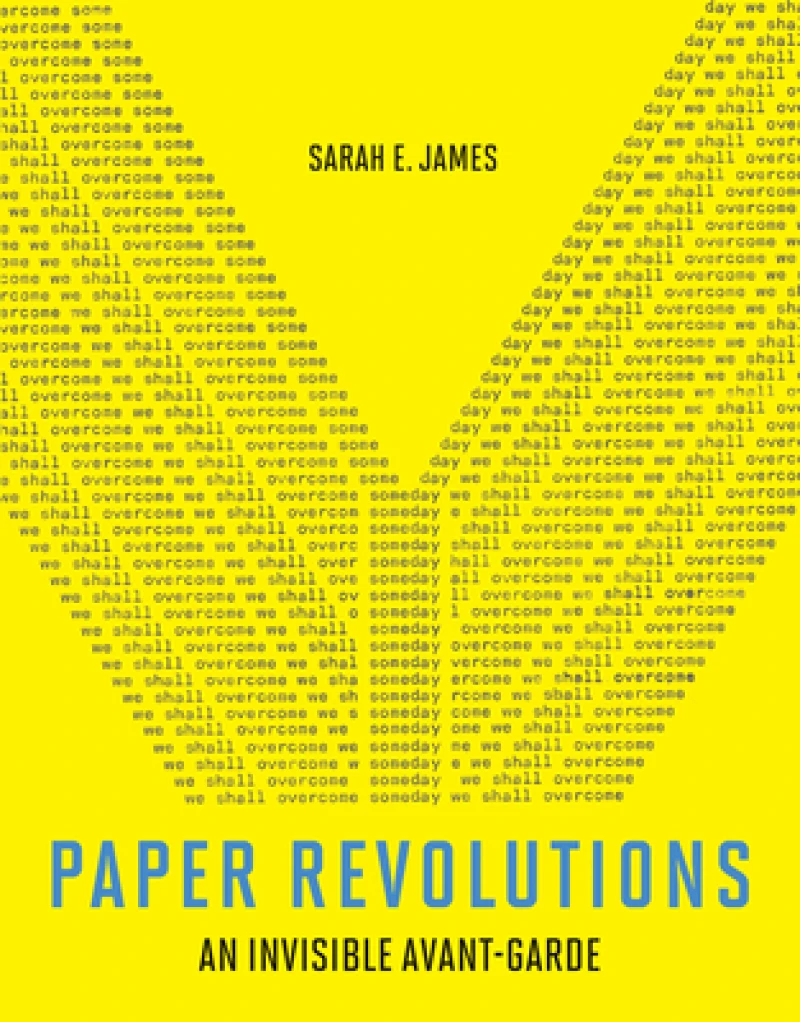
Paper Revolutions : An Invisible Avant-Garde
Book Details
Format
Hardback or Cased Book
ISBN-10
0262046563
ISBN-13
9780262046565
Publisher
MIT Press Ltd
Imprint
MIT Press
Country of Manufacture
GB
Country of Publication
GB
Publication Date
Mar 29th, 2022
Print length
296 Pages
Weight
1,064 grams
Dimensions
18.90 x 23.60 x 3.60 cms
Product Classification:
Theory of art
Ksh 5,750.00
Not available
Delivery in 14 days
1 copies in stock
Delivery Location
Delivery fee: Select location
Delivery in 14 days
Secure
Quality
Fast
The experimental practices of a group of artists in the former East Germany upends assumptions underpinning Western art’s postwar histories. In Paper Revolutions, Sarah James offers a radical rethinking of experimental art in the former East Germany (the GDR). Countering conventional accounts that claim artistic practices in the GDR were isolated and conservative, James introduces a new narrative of neo-avantgarde practice in the Eastern Bloc that subverts many of the assumptions underpinning Western art’s postwar histories. She grounds her argument in the practice of four artists who, uniquely positioned outside academies, museums, and the art market, as these functioned in the West, created art in the blind spots of state censorship. They championed ephemeral practices often marginalized by art history: postcards and letters, maquettes and models, portfolios and artists’ books. Through their “lived modernism,” they produced bodies of work animated by the radical legacies of the interwar avant-garde. James examines the work and daily practices of the constructivist graphic artist, painter, and sculptor Hermann Glöckner; the experimental graphic artist and concrete and sound poet Carlfriedrich Claus; the mail artist, concrete poet, and conceptual artist Ruth Wolf-Rehfeldt; and the mail artist, “visual poet,” and installation artist Karla Sachse. She shows that all of these artists rejected the idea of art as a commodity or a rarefied object, and instead believed in the potential of art to create collectivized experiences and change the world. James argues that these artists, entirely neglected by Western art history, produced some of the most significant experimental art to emerge from Germany during the Cold War.
The experimental practices of a group of artists in the former East Germany upends assumptions underpinning Western arts postwar histories.
In Paper Revolutions, Sarah James offers a radical rethinking of experimental art in the former East Germany (the GDR). Countering conventional accounts that claim artistic practices in the GDR were isolated and conservative, James introduces a new narrative of neo-avantgarde practice in the Eastern Bloc that subverts many of the assumptions underpinning Western arts postwar histories. She grounds her argument in the practice of four artists who, uniquely positioned outside academies, museums, and the art market, as these functioned in the West, created art in the blind spots of state censorship. They championed ephemeral practices often marginalized by art history: postcards and letters, maquettes and models, portfolios and artists books. Through their lived modernism, they produced bodies of work animated by the radical legacies of the interwar avant-garde.
James examines the work and daily practices of the constructivist graphic artist, painter, and sculptor Hermann Glöckner; the experimental graphic artist and concrete and sound poet Carlfriedrich Claus; the mail artist, concrete poet, and conceptual artist Ruth Wolf-Rehfeldt; and the mail artist, visual poet, and installation artist Karla Sachse. She shows that all of these artists rejected the idea of art as a commodity or a rarefied object, and instead believed in the potential of art to create collectivized experiences and change the world. James argues that these artists, entirely neglected by Western art history, produced some of the most significant experimental art to emerge from Germany during the Cold War.
In Paper Revolutions, Sarah James offers a radical rethinking of experimental art in the former East Germany (the GDR). Countering conventional accounts that claim artistic practices in the GDR were isolated and conservative, James introduces a new narrative of neo-avantgarde practice in the Eastern Bloc that subverts many of the assumptions underpinning Western arts postwar histories. She grounds her argument in the practice of four artists who, uniquely positioned outside academies, museums, and the art market, as these functioned in the West, created art in the blind spots of state censorship. They championed ephemeral practices often marginalized by art history: postcards and letters, maquettes and models, portfolios and artists books. Through their lived modernism, they produced bodies of work animated by the radical legacies of the interwar avant-garde.
James examines the work and daily practices of the constructivist graphic artist, painter, and sculptor Hermann Glöckner; the experimental graphic artist and concrete and sound poet Carlfriedrich Claus; the mail artist, concrete poet, and conceptual artist Ruth Wolf-Rehfeldt; and the mail artist, visual poet, and installation artist Karla Sachse. She shows that all of these artists rejected the idea of art as a commodity or a rarefied object, and instead believed in the potential of art to create collectivized experiences and change the world. James argues that these artists, entirely neglected by Western art history, produced some of the most significant experimental art to emerge from Germany during the Cold War.
Get Paper Revolutions by at the best price and quality guaranteed only at Werezi Africa's largest book ecommerce store. The book was published by MIT Press Ltd and it has pages.

