
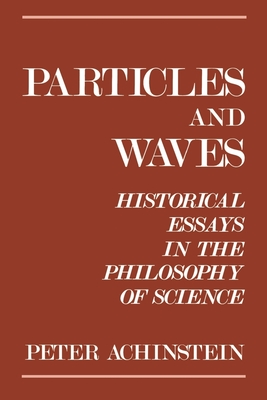
Particles and Waves : Historical Essays in the Philosophy of Science
by
Achinstein
Book Details
Format
Paperback / softback
ISBN-10
019506755X
ISBN-13
9780195067552
Publisher
Oxford University Press Inc
Imprint
Oxford University Press Inc
Country of Manufacture
GB
Country of Publication
GB
Publication Date
Oct 15th, 1992
Print length
352 Pages
Weight
513 grams
Dimensions
23.30 x 15.60 x 2.40 cms
Product Classification:
Photography & photographsPhilosophy of science
KSh 18,050.00
Temporarily out of stock, due soon
0 in stock
Delivery Location
Delivery fee: Select location
Secure
Quality
Fast
This volume brings together six published and two new essays by the noted philosopher of science, Peter Achinstein. It represents the culmination of his examination of methodological issues that arise in nineteenth-century physics. He focuses on the philosophical problem of how, if at all, is it possible to confirm scientific hypotheses that postulate `unobservables' such as light waves, molecules, and electrons? This question is one that not only was of great interest to nineteenth-century physicists and methodologists, but continues to occupy philosophers of science up to the present day.
This volume brings together six published and two new essays by the noted philosopher of science, Peter Achinstein. It represents the culmination of his examination of methodological issues that arise in nineteenth-century physics. He focuses on the philosophical problem of how, if at all, it is possible to confirm scientific hypotheses that postulate `unobservables'' such as light waves, molecules, and electrons. This question is one that not only was of great interest to nineteenth-century physicists and methodologists, but continues to occupy philosophers of science up to the present day.The essays in this volume deal with this vexing problem as it arose in actual scientific practice in three nineteenth-century episodes: the debate between particle and wave theorists of light, Maxwell''s kinetic theory of gases, and J.J. Thomson''s discovery of the electron. Achinstein shows that the most important issue raised by these three cases concerns the legitimacy of introducing hypotheses that invoke "unobservables". If science is to be empirical, can such hypotheses be employed? How, if at all, is it possible to confirm them? Achinstein here assesses the philosophical validity of nineteenth-century and modern answers to these questions and presents and defends his own solutions.
Get Particles and Waves by Achinstein at the best price and quality guaranteed only at Werezi Africa's largest book ecommerce store. The book was published by Oxford University Press Inc and it has 352 pages.
Customers Who Bought This Also Bought

Use of Photography
KSh 2,350.00

Photography
KSh 7,350.00

Mind Over Matter
KSh 6,500.00

What Is It That Will Last?
KSh 8,500.00

Orhan Pamuk: Balkon
KSh 5,400.00

Foster + Partners Portfolio
KSh 8,100.00

Golfing the British Isles
KSh 5,600.00

Growing
KSh 4,300.00

Allowed to Grow Old – Portraits of Elderly Animals from Farm Sanctuaries
KSh 7,850.00

Medea
KSh 11,150.00

The Photograph As Contemporary Art
KSh 2,900.00

Lewis Carroll`s Photography and Modern Childhood
KSh 12,250.00
