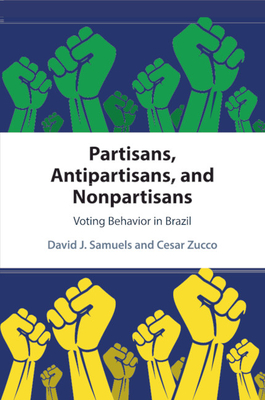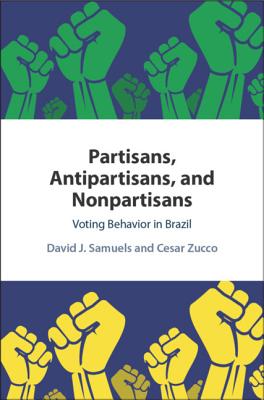
Partisans, Antipartisans, and Nonpartisans : Voting Behavior in Brazil
Book Details
Format
Hardback
ISBN-10
1108428886
ISBN-13
9781108428880
Publisher
Cambridge University Press
Imprint
Cambridge University Press
Country of Manufacture
US
Country of Publication
GB
Publication Date
May 24th, 2018
Print length
196 Pages
Weight
4 grams
Dimensions
15.80 x 23.60 x 1.70 cms
KSh 17,800.00
Currently unavailable
0 in stock
Delivery Location
Delivery fee: Select location
Secure
Quality
Fast
Observers believe few Brazilian voters identify with a political party and, instead, base their choices only on candidates' personal qualities. The authors show that this conventional wisdom is wrong. Many Brazilians have developed a strong affinity for or against a party - which plays an underappreciated role in explaining voter behavior.
Conventional wisdom suggests that partisanship has little impact on voter behavior in Brazil; what matters most is pork-barreling, incumbent performance, and candidates'' charisma. This book shows that soon after redemocratization in the 1980s, over half of Brazilian voters expressed either a strong affinity or antipathy for or against a particular political party. In particular, that the contours of positive and negative partisanship in Brazil have mainly been shaped by how people feel about one party - the Workers'' Party (PT). Voter behavior in Brazil has largely been structured around sentiment for or against this one party, and not any of Brazil''s many others. The authors show how the PT managed to successfully cultivate widespread partisanship in a difficult environment, and also explain the emergence of anti-PT attitudes. They then reveal how positive and negative partisanship shape voters'' attitudes about politics and policy, and how they shape their choices in the ballot booth.
Get Partisans, Antipartisans, and Nonpartisans by Cesar Zucco Jr., David J. Samuels at the best price and quality guaranteed only at Werezi Africa's largest book ecommerce store. The book was published by Cambridge University Press and it has 196 pages.
Customers Who Bought This Also Bought
The Color of Law – A Forgotten History of How Our Government Segregated America
KSh 2,550.00

Prince
KSh 1,100.00
The Prince
KSh 1,800.00

Prince
KSh 3,050.00

January 6 and the Politics of History
KSh 4,650.00

Republic
KSh 2,900.00
Seeing Like a State – How Certain Schemes to Improve the Human Condition Have Failed
KSh 3,550.00

Narrow Corridor
KSh 2,350.00

Abundance
KSh 3,400.00

On the Social Contract
KSh 2,350.00
The Social Contract
KSh 2,000.00
The Athenian Constitution
KSh 2,000.00