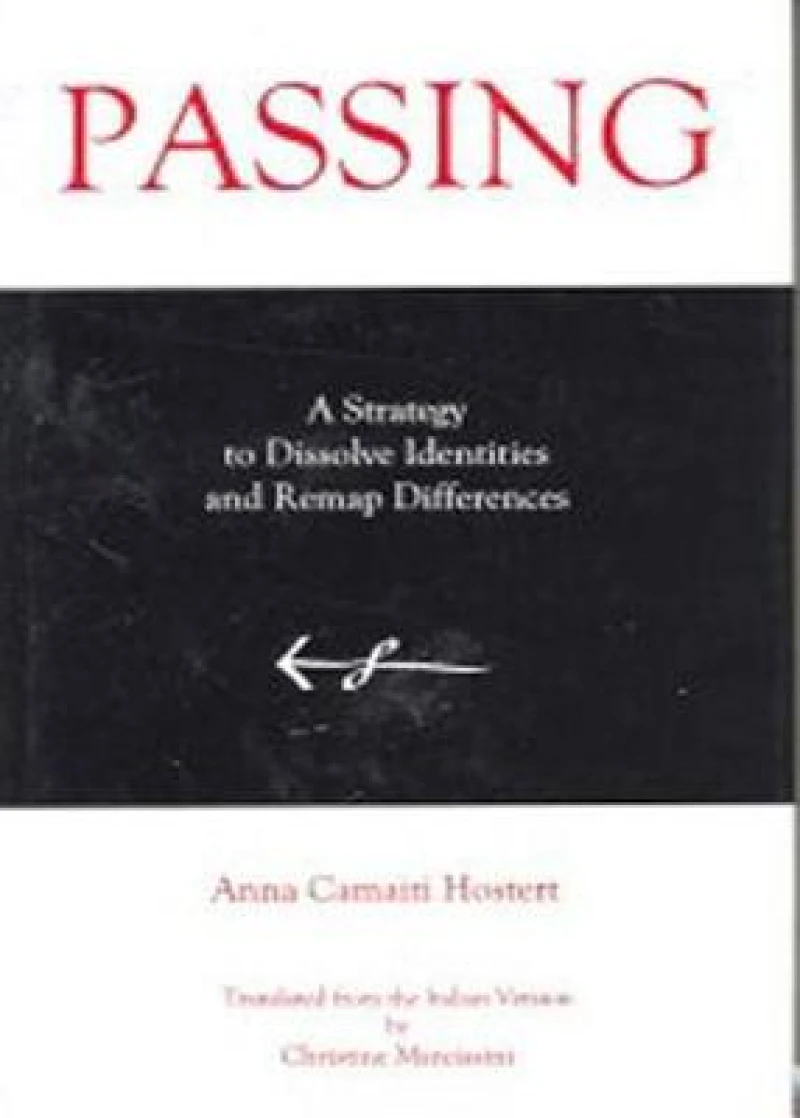
Passing : A Strategy to Dissolve Identities and Revamp Differences
Book Details
Format
Hardback or Cased Book
ISBN-10
1611473527
ISBN-13
9781611473520
Publisher
Fairleigh Dickinson University Press
Imprint
Fairleigh Dickinson University Press
Country of Manufacture
US
Country of Publication
GB
Publication Date
Oct 1st, 2007
Print length
1 Pages
Weight
433 grams
Dimensions
24.50 x 16.80 x 1.50 cms
Product Classification:
Society & culture: general
Ksh 10,250.00
Re-Printing
0 in stock
Delivery Location
Delivery fee: Select location
Secure
Quality
Fast
This book takes its title from the homonymous novel by Nella Larsen who, during the Harlem Renaissance, posed the question of what it means to be black in a racist country. The practice of passing was in fact used by African Americans to escape discrimination during the time of segregation. Nella Larsen condemns this practice, but also shows its potential, defining it as 'not entirely strange perhaps . . . but certainly not entirely friendly.' Starting from this consideration, Camaiti Hostert's book turns the meaning of the social practice of passing upside down and makes it become a universal tool to redefine any social, ethnic, gender, and religious identity. Based on the Foucauldian consideration that total visibility is a 'trap,' the author focuses her attention on the interstices, on the spaces off and on the narratives between the lines. The emphasis is on the transitional moment, in a Gramscian sense: the fluid state flowing between the starting and ending points becomes the place of a counter-hegemony, which helps not only to rewrite history but also to change the political status quo. More interesting than the departure or arrival point is the phase any individual has to go through in order to redefine his/her own self and his/her position in society. It is a deterritorialization of the self and of social practices. It is a way to oppose any form of binary thinking and particularly cultural barriers. Post-colonial literatures, cinema, and new communication technologies that shape the many forms of popular culture are the common ground on which passing relies. From there, from the different conditions of in betweeness, stems the possibility of change.
This book takes its title from the homonymous novel by Nella Larsen who, during the Harlem Renaissance, posed the question of what it means to be black in a racist country. The practice of passing was in fact used by African Americans to escape discrimination during the time of segregation. Nella Larsen condemns this practice, but also shows its potential, defining it as ''not entirely strange perhaps . . . but certainly not entirely friendly.'' Starting from this consideration, Camaiti Hostert''s book turns the meaning of the social practice of passing upside down and makes it become a universal tool to redefine any social, ethnic, gender, and religious identity. Based on the Foucauldian consideration that total visibility is a ''trap,'' the author focuses her attention on the interstices, on the spaces off and on the narratives between the lines. The emphasis is on the transitional moment, in a Gramscian sense: the fluid state flowing between the starting and ending points becomes the place of a counter-hegemony, which helps not only to rewrite history but also to change the political status quo. More interesting than the departure or arrival point is the phase any individual has to go through in order to redefine his/her own self and his/her position in society. It is a deterritorialization of the self and of social practices. It is a way to oppose any form of binary thinking and particularly cultural barriers. Post-colonial literatures, cinema, and new communication technologies that shape the many forms of popular culture are the common ground on which passing relies. From there, from the different conditions of in betweeness, stems the possibility of change.
Get Passing by at the best price and quality guaranteed only at Werezi Africa's largest book ecommerce store. The book was published by Fairleigh Dickinson University Press and it has pages.