
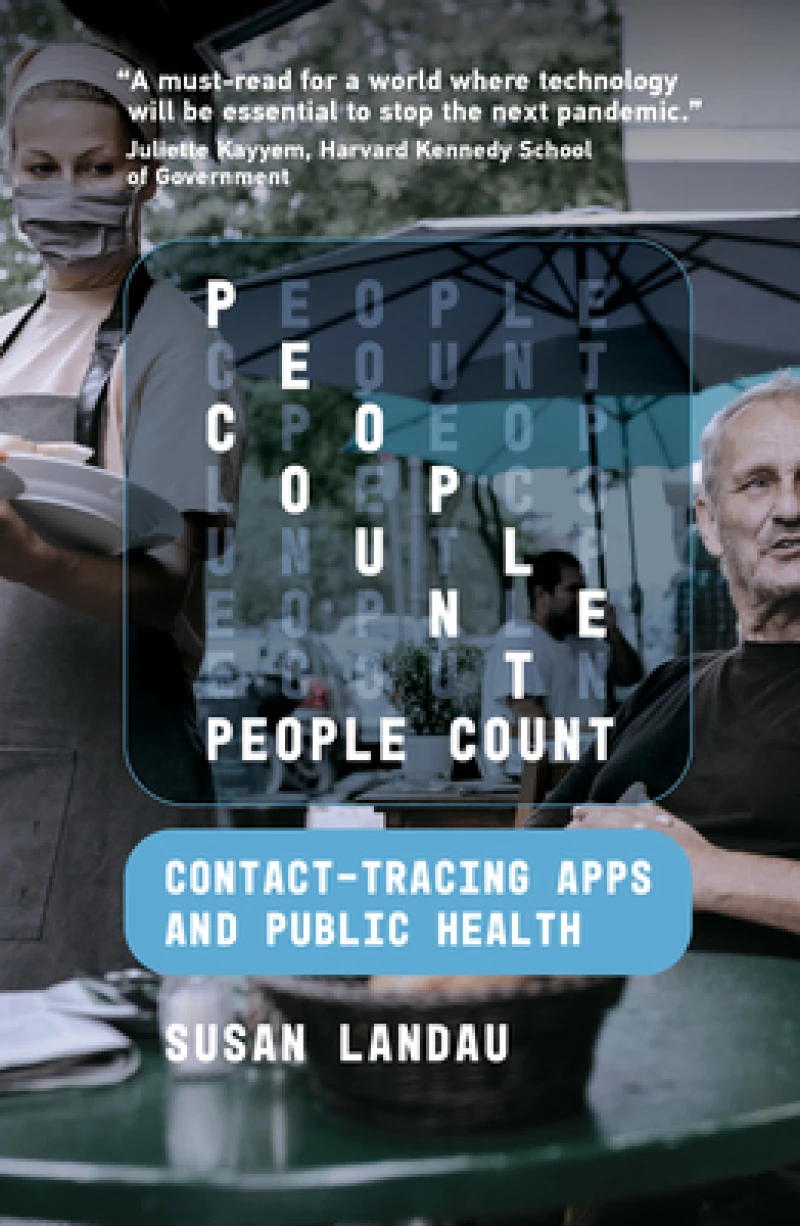
People Count : Contact-Tracing Apps and Public Health
by
Susan Landau
Book Details
Format
Hardback or Cased Book
ISBN-10
0262045710
ISBN-13
9780262045711
Publisher
MIT Press Ltd
Imprint
MIT Press
Country of Manufacture
GB
Country of Publication
GB
Publication Date
Apr 6th, 2021
Print length
120 Pages
Weight
356 grams
Dimensions
14.20 x 21.10 x 2.70 cms
Product Classification:
Technology: general issues
Ksh 4,150.00
Re-Printing
Delivery in 14 days
1 copies in stock
Delivery Location
Delivery fee: Select location
Delivery in 14 days
Secure
Quality
Fast
An introduction to the technology of contact tracing and its usefulness for public health, considering questions of efficacy, equity, and privacy.
How do you stop a pandemic before a vaccine arrives? Contact tracing is key, the first step in a process that has proven effective: trace, test, and isolate. Smartphones can collect some of the information required by contact tracers--not just where you''ve been but also who''s been near you. Can we repurpose the tracking technology that we carry with us--devices with GPS, Wi-Fi, Bluetooth, and social media connectivity--to serve public health in a pandemic? In People Count, cybersecurity expert Susan Landau looks at some of the apps developed for contact tracing during the COVID-19 pandemic, finding that issues of effectiveness and equity intersect.
Landau explains the effectiveness (or ineffectiveness) of a range of technological interventions, including dongles in Singapore that collect proximity information; India''s biometric national identity system; Harvard University''s experiment, TraceFi; and China''s surveillance network. Other nations rejected China-style surveillance in favor of systems based on Bluetooth, GPS, and cell towers, but Landau explains the limitations of these technologies. She also reports that many current apps appear to be premised on a model of middle-class income and a job that can be done remotely. How can they be effective when low-income communities and front-line workers are the ones who are hit hardest by the virus? COVID-19 will not be our last pandemic; we need to get this essential method of infection control right.
How do you stop a pandemic before a vaccine arrives? Contact tracing is key, the first step in a process that has proven effective: trace, test, and isolate. Smartphones can collect some of the information required by contact tracers--not just where you''ve been but also who''s been near you. Can we repurpose the tracking technology that we carry with us--devices with GPS, Wi-Fi, Bluetooth, and social media connectivity--to serve public health in a pandemic? In People Count, cybersecurity expert Susan Landau looks at some of the apps developed for contact tracing during the COVID-19 pandemic, finding that issues of effectiveness and equity intersect.
Landau explains the effectiveness (or ineffectiveness) of a range of technological interventions, including dongles in Singapore that collect proximity information; India''s biometric national identity system; Harvard University''s experiment, TraceFi; and China''s surveillance network. Other nations rejected China-style surveillance in favor of systems based on Bluetooth, GPS, and cell towers, but Landau explains the limitations of these technologies. She also reports that many current apps appear to be premised on a model of middle-class income and a job that can be done remotely. How can they be effective when low-income communities and front-line workers are the ones who are hit hardest by the virus? COVID-19 will not be our last pandemic; we need to get this essential method of infection control right.
Get People Count by at the best price and quality guaranteed only at Werezi Africa's largest book ecommerce store. The book was published by MIT Press Ltd and it has pages.

