
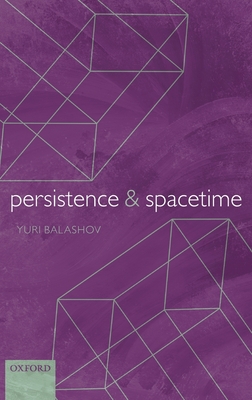
Persistence and Spacetime
Book Details
Format
Hardback
ISBN-10
019957992X
ISBN-13
9780199579921
Publisher
Oxford University Press
Imprint
Oxford University Press
Country of Manufacture
GB
Country of Publication
GB
Publication Date
Apr 29th, 2010
Print length
250 Pages
Weight
541 grams
Dimensions
23.90 x 16.00 x 2.00 cms
KSh 17,700.00
Temporarily out of stock, due soon
0 in stock
Delivery Location
Delivery fee: Select location
Secure
Quality
Fast
How do material objects persist through time and survive change? Are they three-dimensional entities extended in space, but not in time, or are they four-dimensional spacetime "worms"? Yuri Balashov shows how Einstein's theory of relativity supports four-dimensionalism, and in so doing illuminates a wide range of metaphysical issues.
Material objects persist through time and survive change. How do they manage to do so? What are the underlying facts of persistence? Do objects persist by being "wholly present" at all moments of time at which they exist? Or do they persist by having distinct "temporal segments" confined to the corresponding times? Are objects three-dimensional entities extended in space, but not in time? Or are they four-dimensional spacetime "worms"? These are matters of intense debate, which is now driven by concerns about two major issues in fundamental ontology: parthood and location. It is in this context that broadly empirical considerations are increasingly brought to bear on the debate about persistence. Persistence and Spacetime pursues this empirically based approach to the questions. Yuri Balashov begins by setting out major rival views of persistence -- endurance, perdurance, and exdurance -- in a spacetime framework and proceeds to investigate the implications of Einstein''s theory of relativity for the debate about persistence. His overall conclusion -- that relativistic considerations favour four-dimensionalism over three-dimensionalism -- is hardly surprising. It is, however, anything but trivial. Contrary to a common misconception, there is no straightforward argument from relativity to four-dimensionalism. The issues involved are complex, and the debate is closely entangled with a number of other philosophical disputes, including those about the nature and ontology of time, parts and wholes, material constitution, causation and properties, and vagueness.
Get Persistence and Spacetime by Yuri Balashov at the best price and quality guaranteed only at Werezi Africa's largest book ecommerce store. The book was published by Oxford University Press and it has 250 pages.
Customers Who Bought This Also Bought
What I Believe
KSh 2,900.00
Power
KSh 3,250.00

The Collected Papers of Bertrand Russell (Volume 28)
KSh 56,650.00
The Kristeva Critical Reader
KSh 6,100.00
The Historical and Philosophical Significance of Ayer''s Language, Truth and Logic
KSh 19,800.00
The Russell/Bradley Dispute and its Significance for Twentieth Century Philosophy
KSh 18,000.00
Walter Benjamin
KSh 16,200.00

Imagination and Truth
KSh 15,800.00
Leben theoretischer Vernunft
KSh 27,550.00

T&T Clark Reader in Analytic Theology
KSh 6,100.00
Encounters between Analytic and Continental Philosophy
KSh 19,800.00
Walter Benjamin
KSh 16,200.00
More in This Genre
What I Believe
KSh 2,900.00
Power
KSh 3,250.00
The Collected Papers of Bertrand Russell (Volume 28)
KSh 56,650.00
The Kristeva Critical Reader
KSh 6,100.00
The Historical and Philosophical Significance of Ayer''s Language, Truth and Logic
KSh 19,800.00
The Russell/Bradley Dispute and its Significance for Twentieth Century Philosophy
KSh 18,000.00
