
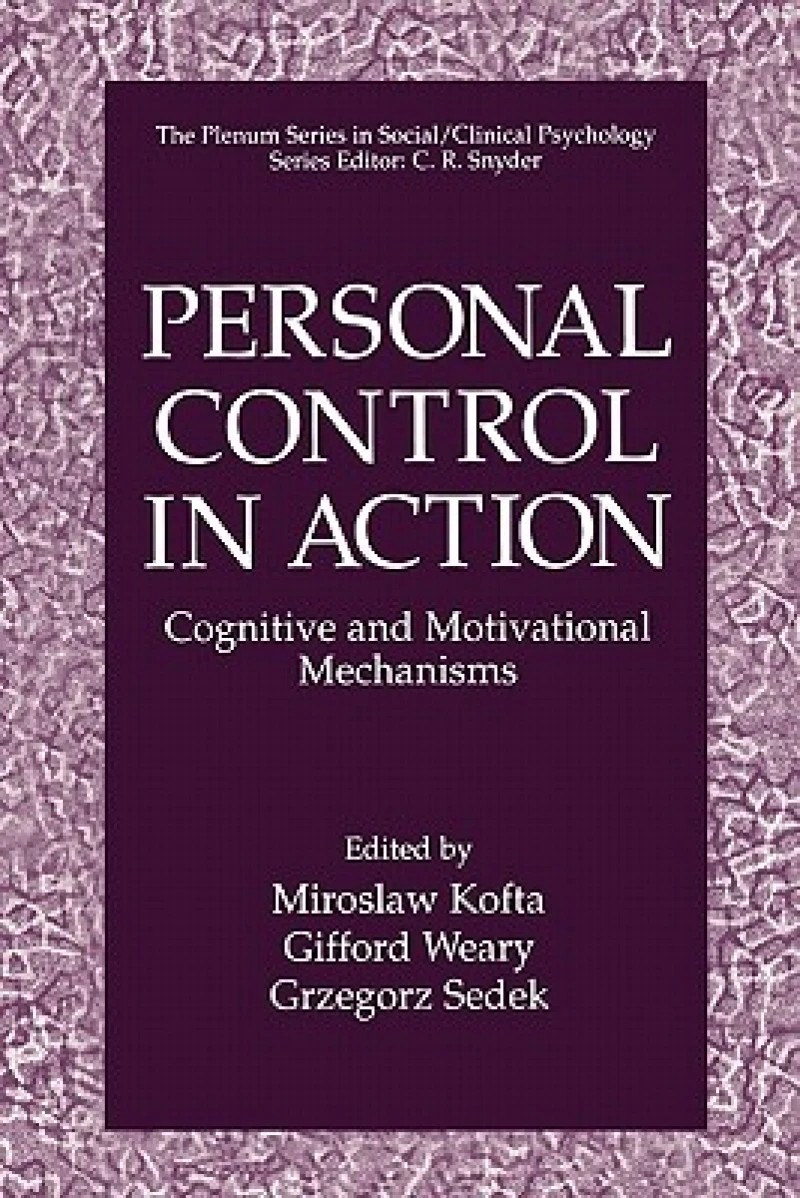
Personal Control in Action : Cognitive and Motivational Mechanisms
1st ed. Softcover of orig. ed. 1998
Book Details
Format
Paperback / Softback
ISBN-10
1441932852
ISBN-13
9781441932853
Edition
1st ed. Softcover of orig. ed. 1998
Publisher
Springer-Verlag New York Inc.
Imprint
Springer-Verlag New York Inc.
Country of Manufacture
US
Country of Publication
GB
Publication Date
Dec 3rd, 2010
Print length
460 Pages
Product Classification:
Cognition & cognitive psychologyThe self, ego, identity, personalityClinical psychology
Ksh 23,400.00
Werezi Extended Catalogue
0 in stock
Delivery Location
Delivery fee: Select location
Secure
Quality
Fast
Human beings are agents: They may exert influence over their own fate. They initiate their actions, experience a considerable degree of freedom and control in their mundane activities, and respond adversely to external constraints to their agency; they are able to monitor and modify their moti- vation, affective states, and behavior. Since the sixties, the notion of person-as-agent has become increas- ingly accepted in scientific psychology. Nowadays, personal control is a standard topic in research on personality, motivation, and social behavior. The most popular approach identifies personal control with a feeling or judgment: To have control means to perceive the self as a source of causa- tion. Within this perspective, such consciously accessible contents like perceived freedom and self-determination, feelings and expectations of control, or perceived self-efficacy and competence emerge as natural tar- gets of research (see e.g., Alloy, Clements, & Koenig, 1993; Bandura, 1977; OeCharms, 1968; Oeci & Ryan, 1985; Harvey, 1976; Rotter, 1966; Thomp- son, 1993; Wortman, 1975).
Human beings are agents: They may exert influence over their own fate. They initiate their actions, experience a considerable degree of freedom and control in their mundane activities, and respond adversely to external constraints to their agency; they are able to monitor and modify their moti vation, affective states, and behavior. Since the sixties, the notion of person-as-agent has become increas ingly accepted in scientific psychology. Nowadays, personal control is a standard topic in research on personality, motivation, and social behavior. The most popular approach identifies personal control with a feeling or judgment: To have control means to perceive the self as a source of causa tion. Within this perspective, such consciously accessible contents like perceived freedom and self-determination, feelings and expectations of control, or perceived self-efficacy and competence emerge as natural tar gets of research (see e.g., Alloy, Clements, & Koenig, 1993; Bandura, 1977; OeCharms, 1968; Oeci & Ryan, 1985; Harvey, 1976; Rotter, 1966; Thomp son, 1993; Wortman, 1975).
Get Personal Control in Action by at the best price and quality guaranteed only at Werezi Africa's largest book ecommerce store. The book was published by Springer-Verlag New York Inc. and it has pages.

