
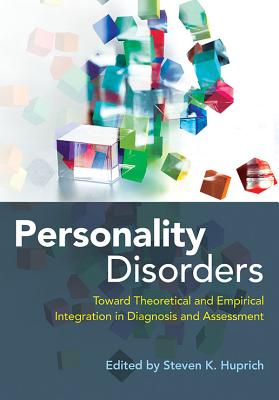
Personality Disorders : Toward Theoretical and Empirical Integration in Diagnosis and Assessment
Book Details
Format
Hardback
ISBN-10
1433818450
ISBN-13
9781433818455
Publisher
American Psychological Association
Imprint
American Psychological Association
Country of Manufacture
US
Country of Publication
GB
Publication Date
Jan 19th, 2015
Print length
452 Pages
Weight
978 grams
Dimensions
18.70 x 26.30 x 3.50 cms
KSh 13,850.00
Temporarily out of stock, due soon
0 in stock
Delivery Location
Delivery fee: Select location
Secure
Quality
Fast
Navigating the intricate landscape of personality disorders, the text delves into debates on assessment and diagnosis. It contrasts categorical, dimensional, and hybrid approaches, weaving together psychodynamic and cognitive models with recent empirical and biogenetic findings to illuminate clinical challenges.
This groundbreaking book offers a comprehensive examination of personality disorders, from conceptual and theoretical concerns to the practical problems faced by assessing clinicians.
What are personality disorders? How should they be conceptualized, and how should they be assessed and diagnosed in clinical practice? For over a century these questions have been at the heart of psychological science. Yet even today, as the recent controversy over proposed changes to the classification of personality disorders in DSM-5 attests, there is hardly consensus on the answers.
Personality Disorders offers a comprehensive and provocative tour of a field that is ripe for integration. Contributors who rank among the world amp rsquo s most prestigious clinical and personality psychologists guide readers through the state of our knowledge of personality disorders, from conceptual and theoretical concerns to the practical problems faced by assessing clinicians. They address the advantages and disadvantages of categorical and dimensional approaches to diagnosing personality pathology used in the standard diagnostic manuals, as well as the amp ldquo hybrid amp rdquo model described in Section III of DSM-5. Recent advances in statistical, methodological, and biogenetic research strategies are applied to the study of personality disorders, with a focus on clinical and empirical approaches to assessment and diagnosis. Theorists describe how psychodynamic, attachment, interpersonal, evolutionary, and cognitive processing approaches offer surprisingly similar models of conceptualizing and treating personality disorders.
What are personality disorders? How should they be conceptualized, and how should they be assessed and diagnosed in clinical practice? For over a century these questions have been at the heart of psychological science. Yet even today, as the recent controversy over proposed changes to the classification of personality disorders in DSM-5 attests, there is hardly consensus on the answers.
Personality Disorders offers a comprehensive and provocative tour of a field that is ripe for integration. Contributors who rank among the world amp rsquo s most prestigious clinical and personality psychologists guide readers through the state of our knowledge of personality disorders, from conceptual and theoretical concerns to the practical problems faced by assessing clinicians. They address the advantages and disadvantages of categorical and dimensional approaches to diagnosing personality pathology used in the standard diagnostic manuals, as well as the amp ldquo hybrid amp rdquo model described in Section III of DSM-5. Recent advances in statistical, methodological, and biogenetic research strategies are applied to the study of personality disorders, with a focus on clinical and empirical approaches to assessment and diagnosis. Theorists describe how psychodynamic, attachment, interpersonal, evolutionary, and cognitive processing approaches offer surprisingly similar models of conceptualizing and treating personality disorders.
Get Personality Disorders by Steven K. Huprich at the best price and quality guaranteed only at Werezi Africa's largest book ecommerce store. The book was published by American Psychological Association and it has 452 pages.
Customers Who Bought This Also Bought

Silent Patient
KSh 2,000.00
Align Your Mind
KSh 3,050.00

Cry of Pain
KSh 3,050.00

The Anatomy of Melancholy
KSh 4,950.00

Outsmart Anxiety
KSh 4,700.00

Book of Books
KSh 2,350.00

Brain Boosting Food for Women with ADHD
KSh 1,450.00

Understanding and Taking Control of Menopausal Symptoms
KSh 30,950.00

Moral Injury and a First World War Chaplain
KSh 5,400.00

Understanding and Taking Control of Menopausal Symptoms
KSh 4,700.00
Deconstructing Anxiety
KSh 5,750.00

Re-Thinking Eating Disorders
KSh 7,000.00
