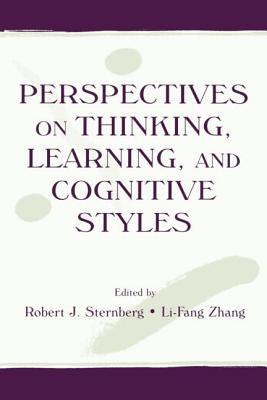
Perspectives on Thinking, Learning, and Cognitive Styles
Book Details
Format
Paperback / Softback
Book Series
Educational Psychology Series
ISBN-10
0805834311
ISBN-13
9780805834314
Publisher
Taylor & Francis Inc
Imprint
Routledge
Country of Manufacture
GB
Country of Publication
GB
Publication Date
Jan 1st, 2001
Print length
286 Pages
Weight
396 grams
Dimensions
22.90 x 15.60 x 1.50 cms
Product Classification:
Cognition & cognitive psychologyEducational psychology
Ksh 12,850.00
Werezi Extended Catalogue
Delivery in 28 days
Delivery Location
Delivery fee: Select location
Delivery in 28 days
Secure
Quality
Fast
This book provides the most comprehensive, balanced, and up-to-date coverage available of theory and research on cognitive, learning, and thinking styles.
This volume presents the most comprehensive, balanced, and up-to-date coverage of theory and research on cognitive, thinking, and learning styles, in a way that:
* represents diverse theoretical perspectives;
* includes solid empirical evidence testing the validity of these perspectives; and
* shows the application of these perspectives to school situations, as well as situations involving other kinds of organizations.
International representation is emphasized, with chapters from almost every major leader in the field of styles. Each chapter author has contributed serious theory and/or published empirical data--work that is primarily commercial or that implements the theories of others.
The book''s central premise is that cognitive, learning, and thinking styles are not abilities but rather preferences in the use of abilities. Traditionally, many psychologists and educators have believed that people''s successes and failures are attributable mainly to individual differences in abilities. However, for the past few decades research on the roles of thinking, learning, and cognitive styles in performance within both academic and nonacademic settings has indicated that they account for individual differences in performance that go well beyond abilities. New theories better differentiate styles from abilities and make more contact with other psychological literatures; recent research, in many cases, is more careful and conclusive than are some of the older studies.
Cognitive, learning, and thinking styles are of interest to educators because they predict academic performance in ways that go beyond abilities, and because taking styles into account can help teachers to improve both instruction and assessment and to show sensitivity to cultural and individual diversity among learners. They are also of interest in business, where instruments to assess styles are valuable in selecting and placing personnel. The state-of-the-art research and theory in this volume will be of particular interest to scholars and graduate students in cognitive and educational psychology, managers, and others concerned with intellectual styles as applied in educational, industrial, and corporate settings.
* represents diverse theoretical perspectives;
* includes solid empirical evidence testing the validity of these perspectives; and
* shows the application of these perspectives to school situations, as well as situations involving other kinds of organizations.
International representation is emphasized, with chapters from almost every major leader in the field of styles. Each chapter author has contributed serious theory and/or published empirical data--work that is primarily commercial or that implements the theories of others.
The book''s central premise is that cognitive, learning, and thinking styles are not abilities but rather preferences in the use of abilities. Traditionally, many psychologists and educators have believed that people''s successes and failures are attributable mainly to individual differences in abilities. However, for the past few decades research on the roles of thinking, learning, and cognitive styles in performance within both academic and nonacademic settings has indicated that they account for individual differences in performance that go well beyond abilities. New theories better differentiate styles from abilities and make more contact with other psychological literatures; recent research, in many cases, is more careful and conclusive than are some of the older studies.
Cognitive, learning, and thinking styles are of interest to educators because they predict academic performance in ways that go beyond abilities, and because taking styles into account can help teachers to improve both instruction and assessment and to show sensitivity to cultural and individual diversity among learners. They are also of interest in business, where instruments to assess styles are valuable in selecting and placing personnel. The state-of-the-art research and theory in this volume will be of particular interest to scholars and graduate students in cognitive and educational psychology, managers, and others concerned with intellectual styles as applied in educational, industrial, and corporate settings.
Get Perspectives on Thinking, Learning, and Cognitive Styles by at the best price and quality guaranteed only at Werezi Africa's largest book ecommerce store. The book was published by Taylor & Francis Inc and it has pages.