
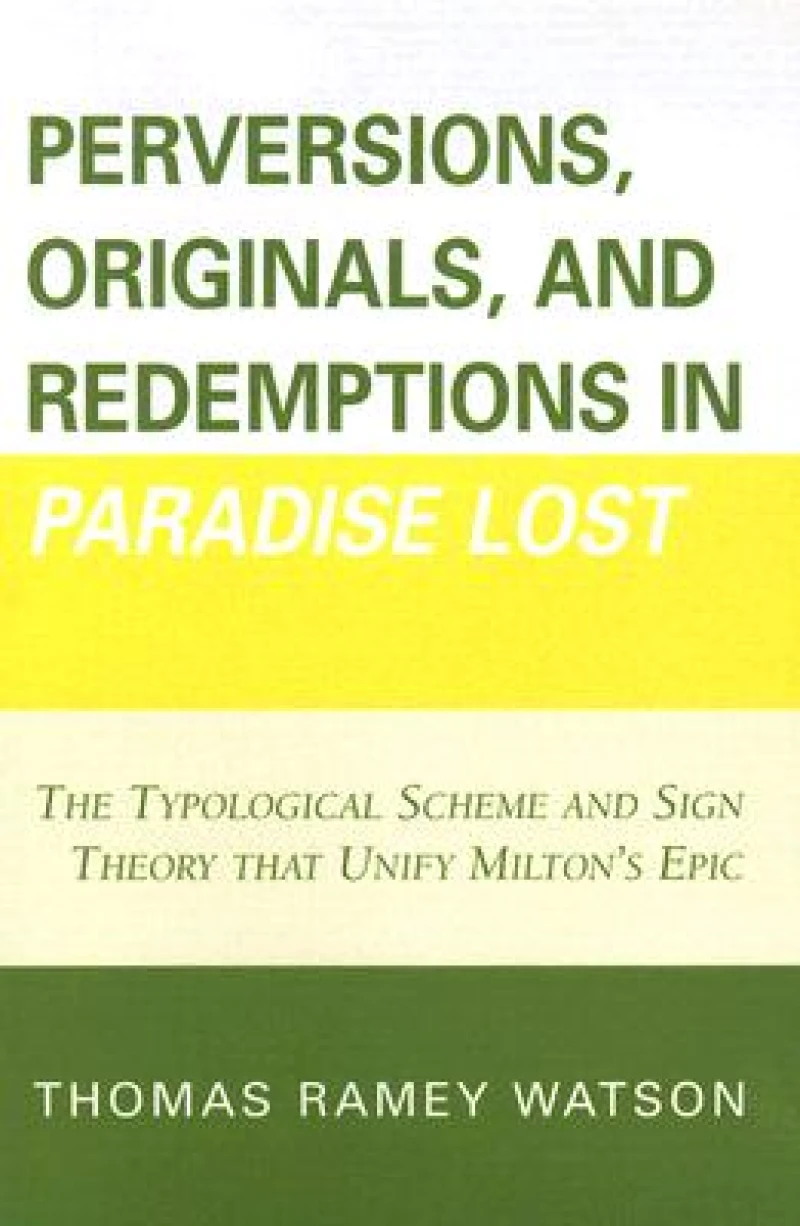
Perversions, Originals, and Redemptions in Paradise Lost : The Typological Scheme and Sign Theory that Unify Milton's Epic
Book Details
Format
Paperback / Softback
ISBN-10
0761837825
ISBN-13
9780761837824
Publisher
University Press of America
Imprint
University Press of America
Country of Manufacture
GB
Country of Publication
GB
Publication Date
Jun 20th, 2007
Print length
200 Pages
Weight
308 grams
Dimensions
23.10 x 15.30 x 1.70 cms
Product Classification:
Literature: history & criticismLiterature: history and criticism
Ksh 8,450.00
Manufactured on Demand
0 in stock
Delivery Location
Delivery fee: Select location
Secure
Quality
Fast
In his epic Paradise Lost, John Milton employs, extends, and deepens the typological scheme that he believed to be embodied in, and known by, a close comparison of the scriptures of the Old and New Testaments. Using biblical typology as a point of departure, whereby the Hebraic scriptures are interpreted as prefigurations of the Christian New Testament, Milton developed a ''sign theory,'' or semiotics, of his own. Like Saint Augustine, the first great and foremost framer of sign theory and Christian typology in the West, Milton believed that knowledge of typology and sign theory was crucial to understanding God''s existence, power, and purpose in creation. Milton''s achievement was to dramatize this sign theory in his poetry, especially Paradise Lost. Professor Thomas Ramey Watson''s analysis of Milton''s sign theory begins with the context and framework of Augustinian sign theory and Milton''s adaptation thereof. Professor Watson then explores the essential conflicts between St. Augustine''s ''City of God'' and ''City of Man'' to contrast the godhead in Paradise Lost with the satanic underworld. Emphasizing Adam''s dream-vision in Books 11 and 12, and the instruction he receives from the Archangel Michael in reading signs correctly, Professor Watson explores indepth the trajectory of Adam and Eve''s downfall and subsequent resignation and regeneration.
Get Perversions, Originals, and Redemptions in Paradise Lost by at the best price and quality guaranteed only at Werezi Africa's largest book ecommerce store. The book was published by University Press of America and it has pages.

