
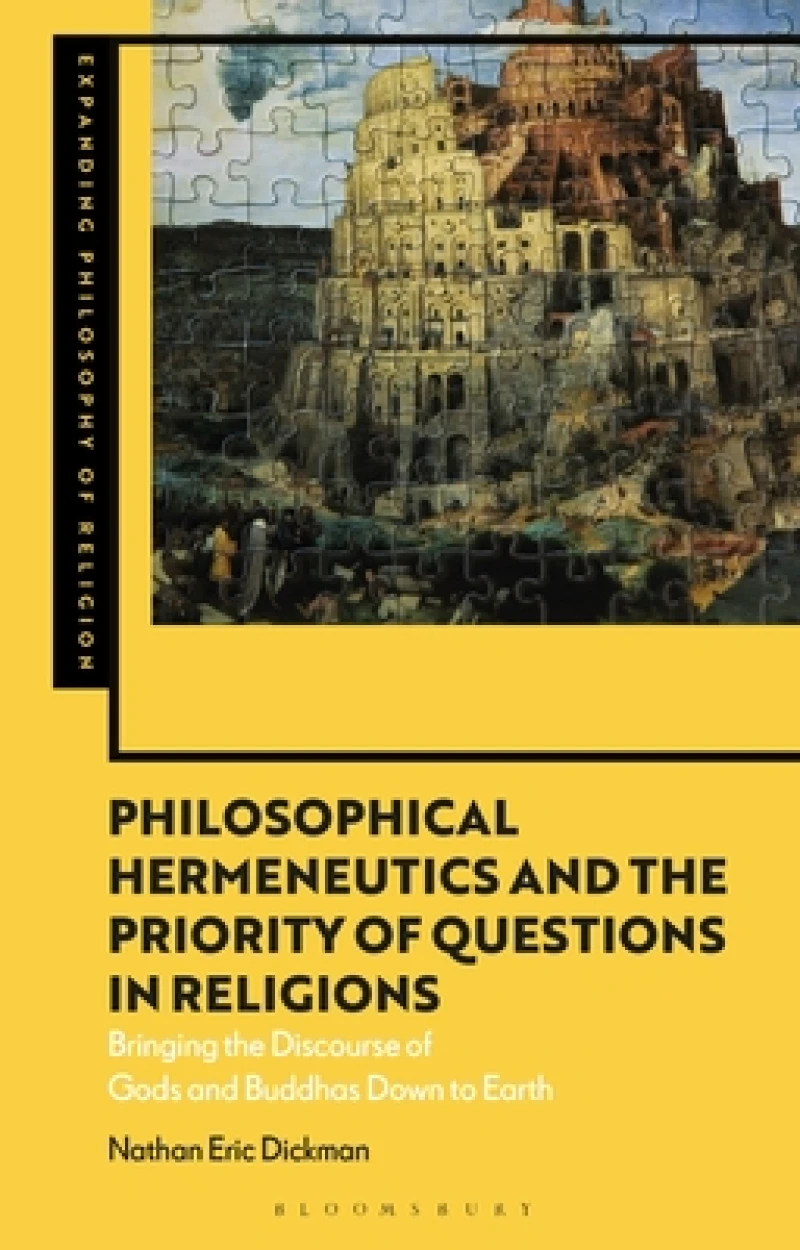
Philosophical Hermeneutics and the Priority of Questions in Religions : Bringing the Discourse of Gods and Buddhas Down to Earth
Book Details
Format
Paperback / Softback
Book Series
Expanding Philosophy of Religion
ISBN-10
1350202142
ISBN-13
9781350202146
Publisher
Bloomsbury Publishing PLC
Imprint
Bloomsbury Academic
Country of Manufacture
GB
Country of Publication
GB
Publication Date
Mar 24th, 2022
Print length
224 Pages
Weight
300 grams
Dimensions
21.40 x 13.80 x 1.80 cms
Product Classification:
PhilosophyPhilosophy of religionHistory of ideas
Ksh 4,300.00
Werezi Extended Catalogue
0 in stock
Delivery Location
Delivery fee: Select location
Secure
Quality
Fast
Buddhas, gods, prophets and oracles are often depicted as asking questions. But what are we to understand when Jesus asks “Who do you say that I am?”, or Mazu, the Classical Zen master asks, “Why do you seek outside?" Is their questioning a power or weakness? Is it something human beings are only capable of due to our finitude? Is there any kind of question that is a power?Focusing on three case studies of questions in divine discourse on the level of story - the god depicted in the Jewish Bible, the master Mazu in his recorded sayings literature, and Jesus as he is depicted in canonized Christian Gospels - Nathan Eric Dickman meditates on human responses to divine questions. He considers the purpose of interreligious dialogue and the provocative kind of questions that seem to purposefully decenter us, drawing on methods from confessionally-oriented hermeneutics and skills from critical thinking. He allows us to see alternative ways of interpreting religious texts through approaches that look beyond reading a text for the improvement of our own religion or for access to some metaphysically transcendent reality. This is the first step in a phenomenology of religions that is inclusive, diverse, relevant and grounded in the world we live in.
Buddhas, gods, prophets and oracles are often depicted as asking questions. But what are we to understand when Jesus asks “Who do you say that I am?”, or Mazu, the Classical Zen master asks, “Why do you seek outside?" Is their questioning a power or weakness? Is it something human beings are only capable of due to our finitude? Is there any kind of question that is a power?Focusing on three case studies of questions in divine discourse on the level of story - the god depicted in the Jewish Bible, the master Mazu in his recorded sayings literature, and Jesus as he is depicted in canonized Christian Gospels - Nathan Eric Dickman meditates on human responses to divine questions. He considers the purpose of interreligious dialogue and the provocative kind of questions that seem to purposefully decenter us, drawing on methods from confessionally-oriented hermeneutics and skills from critical thinking. He allows us to see alternative ways of interpreting religious texts through approaches that look beyond reading a text for the improvement of our own religion or for access to some metaphysically transcendent reality. This is the first step in a phenomenology of religions that is inclusive, diverse, relevant and grounded in the world we live in.
Get Philosophical Hermeneutics and the Priority of Questions in Religions by at the best price and quality guaranteed only at Werezi Africa's largest book ecommerce store. The book was published by Bloomsbury Publishing PLC and it has pages.

