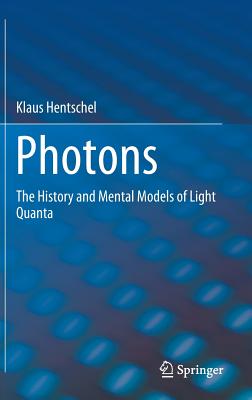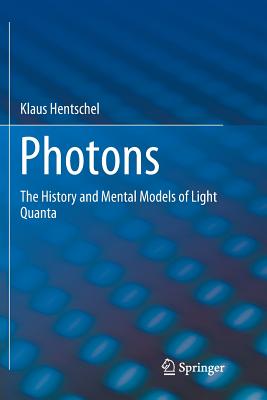
Photons : The History and Mental Models of Light Quanta
Softcover Reprint of the Original 1st 2018 ed.
Book Details
Format
Paperback / softback
ISBN-10
3030070018
ISBN-13
9783030070014
Edition
Softcover Reprint of the Original 1st 2018 ed.
Publisher
Springer Nature Switzerland AG
Imprint
Springer Nature Switzerland AG
Country of Manufacture
GB
Country of Publication
GB
Publication Date
Dec 28th, 2018
Print length
231 Pages
KSh 14,400.00
Currently unavailable
0 in stock
Delivery Location
Delivery fee: Select location
Secure
Quality
Fast
This book focuses on the gradual formation of the concept of ‘light quanta’ or ‘photons’, as they have usually been called in English since 1926. The great number of synonyms that have been used by physicists to denote this concept indicates that there are many different mental models of what ‘light quanta’ are: simply finite, ‘quantized packages of energy’ or ‘bullets of light’? ‘Atoms of light’ or ‘molecules of light’? ‘Light corpuscles’ or ‘quantized waves’? Singularities of the field or spatially extended structures able to interfere? ‘Photons’ in G.N. Lewis’s sense, or as defined by QED, i.e. virtual exchange particles transmitting the electromagnetic force?The term ‘light quantum’ made its first appearance in Albert Einstein’s 1905 paper on a “heuristic point of view” to cope with the photoelectric effect and other forms of interaction of light and matter, but the mental model associated with it has a rich history both before and after 1905. Some ofits semantic layers go as far back as Newton and Kepler, some are only fully expressed several decades later, while others initially increased in importance then diminished and finally vanished. In conjunction with these various terms, several mental models of light quanta were developed—six of them are explored more closely in this book. It discusses two historiographic approaches to the problem of concept formation: (a) the author’s own model of conceptual development as a series of semantic accretions and (b) Mark Turner’s model of ‘conceptual blending’. Both of these models are shown to be useful and should be explored further. This is the first historiographically sophisticated history of the fully fledged concept and all of its twelve semantic layers. It systematically combines the history of science with the history of terms and a philosophically inspired history of ideas in conjunction with insights from cognitive science.
Get Photons by Klaus Hentschel at the best price and quality guaranteed only at Werezi Africa's largest book ecommerce store. The book was published by Springer Nature Switzerland AG and it has 231 pages.
Customers Who Bought This Also Bought

Anaximander
KSh 2,000.00

When Breath Becomes Air
KSh 1,800.00

On the Origin of Species
KSh 1,600.00

Origin of Species
KSh 1,850.00

There Are Places in the World Where Rules Are Less Important Than Kindness
KSh 2,350.00

Every Living Thing
KSh 2,350.00

Everything Is Tuberculosis
KSh 3,950.00
Short History of Nearly Everything 2.0
KSh 3,550.00

Short History of Nearly Everything
KSh 2,350.00

Classics Origin of Species
KSh 1,100.00

Essential Galileo
KSh 2,900.00
Helgoland
KSh 2,350.00