
Cart 0
Pi: The Next Generation
Click to zoom

Share this book

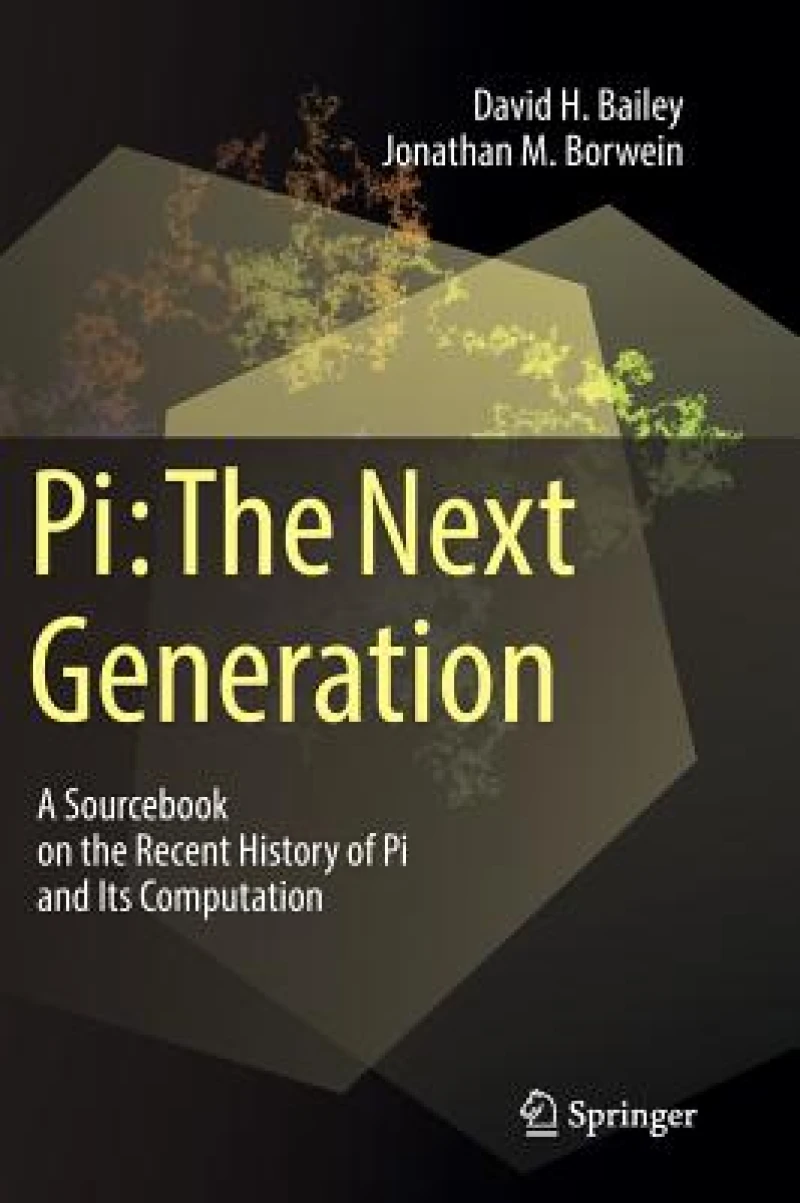
Pi: The Next Generation : A Sourcebook on the Recent History of Pi and Its Computation

1st ed. 2016

Book Details

Format Hardback or Cased Book
ISBN-10 331932375X
ISBN-13 9783319323756
Edition 1st ed. 2016
Publisher Springer International Publishing AG
Imprint Springer International Publishing AG
Country of Manufacture CH
Country of Publication GB
Publication Date Aug 5th, 2016
Print length 507 Pages
Weight 1,174 grams
Dimensions 18.60 x 26.30 x 3.60 cms
Ksh 14,400.00
Werezi Extended Catalogue Delivery in 28 days

Delivery Location

Delivery fee: Select location

Delivery in 28 days

Secure
Quality
Fast
This book contains a compendium of 25 papers published since the 1970s dealing with pi and associated topics of mathematics and computer science.  The collection begins with a Foreword by Bruce Berndt. Each contribution is preceded by a brief summary of its content as well as a short key word list indicating how the content relates to others in the collection. The volume includes articles on actual computations of pi, articles on mathematical questions related to pi (e.g., “Is pi normal?”), articles presenting new and often amazing techniques for computing digits of pi (e.g., the “BBP” algorithm for pi, which permits one to compute an arbitrary binary digit of pi without needing to compute any of the digits that came before), papers presenting important fundamental mathematical results relating to pi, and papers presenting new, high-tech techniques for analyzing pi (i.e., new graphical techniques that permit one to visually see if pi and other numbers are “normal”).  This volume is a companion to Pi: A Source Book whose third edition released in 2004.  The present collection begins with 2 papers from 1976, published by Eugene Salamin and Richard Brent, which describe “quadratically convergent” algorithms for pi and other basic mathematical functions, derived from some mathematical work of Gauss. Bailey and Borwein hold that these two papers constitute the beginning of the modern era of computational mathematics.  This time period (1970s) also corresponds with the introduction of high-performance computer systems (supercomputers), which since that time have increased relentlessly in power, by approximately a factor of 100,000,000, advancing roughly at the same rate as Moore’s Law of semiconductor technology.  This book may be of interest to a wide range of mathematical readers; some articles cover more advanced research questions suitable for active researchers in the field, but several are highly accessible to undergraduate mathematics students.

This book contains a compendium of 25 papers published since the 1970s dealing with pi and associated topics of mathematics and computer science.  The collection begins with a Foreword by Bruce Berndt. Each contribution is preceded by a brief summary of its content as well as a short key word list indicating how the content relates to others in the collection. The volume includes articles on actual computations of pi, articles on mathematical questions related to pi (e.g., "Is pi normal?"), articles presenting new and often amazing techniques for computing digits of pi (e.g., the "BBP" algorithm for pi, which permits one to compute an arbitrary binary digit of pi without needing to compute any of the digits that came before), papers presenting important fundamental mathematical results relating to pi, and papers presenting new, high-tech techniques for analyzing pi (i.e., new graphical techniques that permit one to visually see if pi and other numbers are "normal").  

This volume is a companion to Pi: A Source Book whose third edition released in 2004.  The present collection begins with 2 papers from 1976, published by Eugene Salamin and Richard Brent, which describe "quadratically convergent" algorithms for pi and other basic mathematical functions, derived from some mathematical work of Gauss. Bailey and Borwein hold that these two papers constitute the beginning of the modern era of computational mathematics.  This time period (1970s) also corresponds with the introduction of high-performance computer systems (supercomputers), which since that time have increased relentlessly in power, by approximately a factor of 100,000,000, advancing roughly at the same rate as Moore''s Law of semiconductor technology.  This book may be of interest to a wide range of mathematical readers; some articles cover more advanced research questions suitable for active researchers in the field, but several are highly accessible to undergraduate mathematics students.


Get Pi: The Next Generation by at the best price and quality guaranteed only at Werezi Africa's largest book ecommerce store. The book was published by Springer International Publishing AG and it has pages.


Mind, Body, & Spirit

Price

Ksh 14,400.00

Shopping Cart

Africa largest book store

Sub Total:
Ebooks

Digital Library
Coming Soon

Our digital collection is currently being curated to ensure the best possible reading experience on Werezi. We'll be launching our Ebooks platform shortly.