
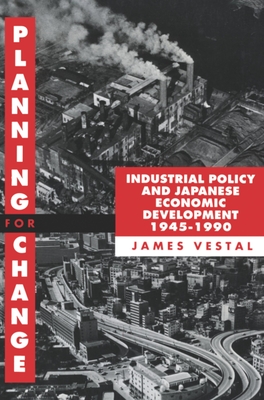
Planning for Change : Industrial Policy and Japanese Economic Development 1945-1990
Book Details
Format
Paperback / softback
ISBN-10
0198290276
ISBN-13
9780198290278
Publisher
Oxford University Press
Imprint
Oxford University Press
Country of Manufacture
GB
Country of Publication
GB
Publication Date
Oct 26th, 1995
Print length
256 Pages
Weight
396 grams
Dimensions
15.60 x 23.20 x 1.70 cms
KSh 5,700.00
Currently unavailable
0 in stock
Delivery Location
Delivery fee: Select location
Secure
Quality
Fast
This study evaluates the role that government industrial policy, through agencies such as MITI, has played in Japan's extraordinary post-war development. It shows that a stable, gradual and long-term perspective was the key to Japan's development.
What has been the role of government industrial policy in Japan''s extraordinary post-war development? How has the role changed in successive phases of growth? What "lessons" can be learnt from this experience by other nations, be they in the West, or developing countries or economies in transition attempting to introduce competitive market structures? These are some of the main questions addressed in this absorbing and thorough study. Dividing the period into three main phases, the author shows that policy played a crucial role in the initial period of post-war recovery. It did so not by "picking winners" but by creating a stable base from which development could occur by spreading the cost of introducing market competition over time. In the succeeding high growth period, and more recently, Japan''s industrial policy attempts only to promote the development of new technology, and smoothe the decline of sectors that are no longer globally competitive. That Japan itself no longer practices industrial policy on a wide scale is an irony little appreciated by those advocating the adoption of a "Japan-style" industrial policy elswhere.
Get Planning for Change by James E. Securities, Tokyo; Visiting Lecturer, Chief Economist, Barclays de Zoete Wedd (BZW) Secur at the best price and quality guaranteed only at Werezi Africa's largest book ecommerce store. The book was published by Oxford University Press and it has 256 pages.
Customers Who Bought This Also Bought

The White Man''s Burden
KSh 2,900.00

We Are Not Able to Live in the Sky
KSh 3,400.00

New Confessions of an Economic Hit Man
KSh 2,700.00

Good Economics for Hard Times
KSh 2,350.00

The Bottom Billion
KSh 2,500.00

How to Win a Trade War
KSh 3,050.00

World for Sale
KSh 2,150.00

Trade Wars Are Class Wars – How Rising Inequality Distorts the Global Economy and Threatens International Peace
KSh 2,600.00

Capital and Ideology
KSh 7,450.00

Doom Loop
KSh 4,150.00

Shared Prosperity in a Fractured World
KSh 4,000.00
Big Con
KSh 2,350.00
