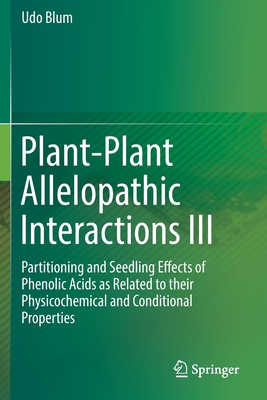
Plant-Plant Allelopathic Interactions III : Partitioning and Seedling Effects of Phenolic Acids as Related to their Physicochemical and Conditional Properties
2019 ed.
Book Details
Delivery Location
Delivery fee: Select location
This volume continues the retrospective analyses of Volumes I and II, but goes beyond that in an attempt to understand how phenolic acids are partitioned in seedling-solution and seedling-microbe-soil-sand culture systems and how phenolic acid effects on seedlings may be related to the actual and/or conditional physicochemical properties (e.g., solubility, hydrophobicity, pKa, molecular structure and soil sorption/desorption) of simple phenolic acids. Specifically, it explores the quantitative partitioning (i.e., source-sink relationships) of benzoic and cinnamic acids in cucumber seedling-solution and cucumber seedling-microbe-soil-sand systems and how that partitioning may influence phenolic acid effects on cucumber seedlings. Regressions, correlations and conceptual and hypothetical models are used to achieve these objectives. Cucumber seedlings are used as a surrogate for phenolic acid sensitive herbaceous dicotyledonous weed seedlings. This volume was written specifically for researchers and their students interested in understanding how a range of simple phenolic acids and potentially other putative allelopathic compounds released from living plants and their litter and residues may modify soil chemistry, soil and rhizosphere microbial biology, seedling physiology and seedling growth. In addition, this volume describes the potential relationships, where they may exist, for direct transfer of organic compounds between plants, plant communication and plant-plant allelopathic interactions and addresses the following questions: Can physicochemical properties of phenolic acids be used as tools to help understand the complex behavior of phenolic acids and the ultimate effects of phenolic acids on sensitive seedlings? What insights do laboratory bioassays and the conceptual and hypothetical models of laboratory systems provide us concerning the potential behavior and effects of phenolic acids in field systems? What potential role may phenolic acids play in broadleaf-weed seedling emergence in wheat debris cover crop no-till systems?
Get Plant-Plant Allelopathic Interactions III by Udo Blum at the best price and quality guaranteed only at Werezi Africa's largest book ecommerce store. The book was published by Springer Nature Switzerland AG and it has 503 pages.
Customers Who Bought This Also Bought

Is a River Alive?
KSh 2,150.00

Heretics Of Dune
KSh 2,000.00

Blue Machine
KSh 2,150.00

Genius of Trees
KSh 4,500.00

Genius of Trees
KSh 3,050.00

Genius of Trees
KSh 2,350.00

For Everyone Bible Study Guide: James
KSh 1,250.00

Deep History of Ourselves
KSh 3,250.00

Deep History of Ourselves
KSh 5,400.00

Is a River Alive?
KSh 4,500.00

Kinship: Vol. 5 Practice
KSh 3,250.00
Aristotle's Classification of Animals
KSh 14,400.00