
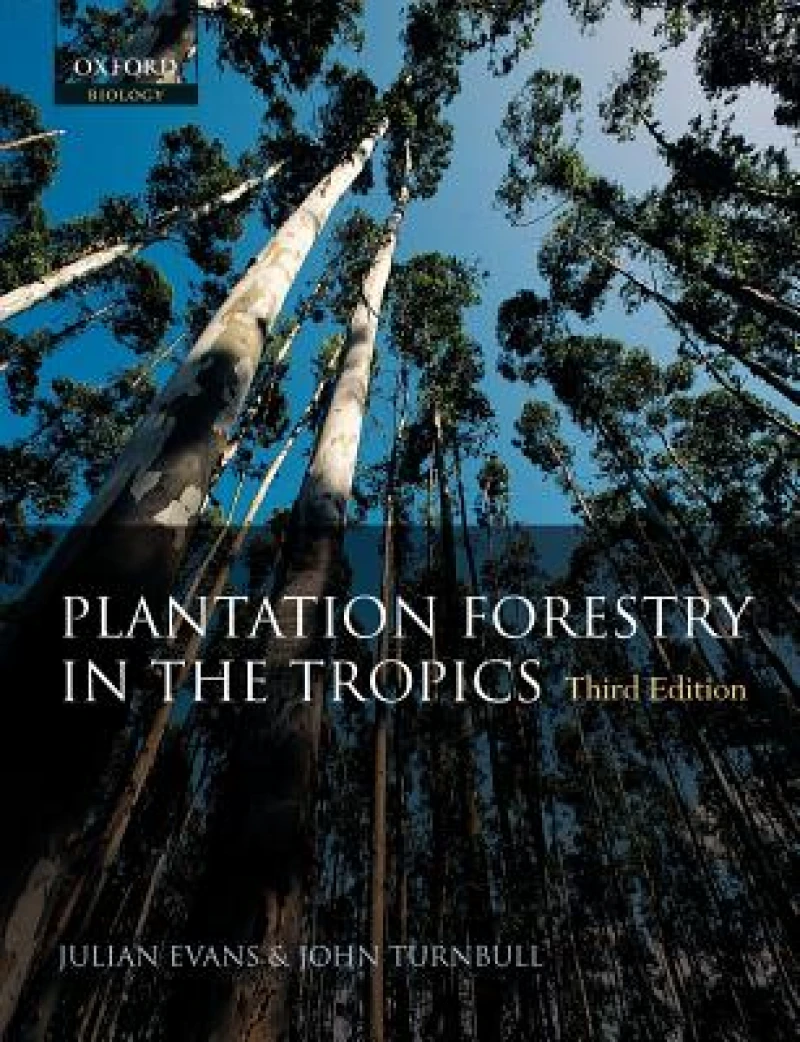
Plantation Forestry in the Tropics : The role, silviculture and use of planted forests for industrial, social, environmental and agroforestry purposes
3 Revised edition
Book Details
Format
Paperback / Softback
ISBN-10
0198509472
ISBN-13
9780198509479
Edition
3 Revised edition
Publisher
Oxford University Press
Imprint
Oxford University Press
Country of Manufacture
GB
Country of Publication
GB
Publication Date
Apr 15th, 2004
Print length
482 Pages
Weight
1,068 grams
Dimensions
24.60 x 18.90 x 2.50 cms
Product Classification:
Development studiesThe environmentForestry & silviculture: practice & techniques
Ksh 14,150.00
Manufactured on Demand
0 in stock
Delivery Location
Delivery fee: Select location
Secure
Quality
Fast
Development of planted forests in tropical and subtropical countries is accelerating to satisfy the ever-growing global demand for wood products. This work provides an overview that sets plantation silviculture in the context of development processes and their social, environmental and ecological impacts.
Development of planted forests in tropical and subtropical countries is accelerating to satisfy the ever-growing global demand for wood products. Indeed, it is expected that within 20 years half of all wood fibre in the world will be sourced from plantations, of which more than half are in the tropics and subtropics. As well as intensively managed industrial wood plantations, trees are increasingly being planted as part of farming systems - to control erosion and rehabilitate degraded lands and forests. Active community involvement in tree planting as part of rural development is now widespread and welcome. Plantation Forestry in the Tropics provides an overview that sets plantation silviculture in the wider context of development processes and their social, environmental and ecological impacts. The structure and approach of previous editions have been retained but every chapter has been comprehensively revised and updated. Two new chapters, one on clonal forestry, the other on ecological restoration, have also been added although the central theme remains the silviculture that underpins successful industrial planted forests. Overall, the book provides an up-to-date account of silvicultural practices, some of the socio-economic essentials, and the key role tree planting now plays in natural resource management and improving rural livelihoods in the tropics. Contemporary issues such as full stakeholder participation and sustainable management practices in planted forests are also addressed. The authors have drawn on their field experience from over 40 tropical and sub-tropical countries, and readers will find examples from Africa, Latin America, tropical Asia and the Pacific. Both the historical context and recent developments are presented, and examples are drawn from industrial plantations, rural development plantings, agroforestry and tree planting for soil protection and rehabilitation of degraded forests. Students, professional foresters, development specialists, and all with an interest in tropical forest management will find this a valuable reference text.
Development of planted forests in tropical and subtropical countries is accelerating to satisfy the ever-growing global demands for wood products. Indeed, it is expected that within 20 years half of all wood fibre in the world will be sourced from plantations, of which more than half are in the tropics and subtropics. As well as intensively-managed, industrial wood plantations, trees are increasingly being planted as part of farming systems, and to control erosion and rehabilitate degraded lands and forests. Active community involvement in tree planting as part of rural development is now widespread and welcome. This book provides an overview that sets plantation silviculture in the wider context of the development processes and their social, environmental and ecological impacts.For this new edition, the structure and approach of previous editions have been retained but every chapter has been comprehensively revised and updated. Two new chapters - ''clonal forestry'' and ''ecological restoration'' - have been added. The central theme remains the silviculture that underpins successful industrial planted forests. Overall the book provides an up-to-date account of silvicultural practices, some of the socio-economic essentials and the key role tree planting now plays in natural resource management and improving rural livelihoods in the tropics. Contemporary issues such as full stakeholder participation and sustainable management practices in planted forests are also addressed.This expanded third edition provides a comprehensive introduction to plantation forestry practices in the tropics as part of sustainable land use. Both the historical context and recent developments are presented so that students, professional foresters, development specialists, and all with an interest in tropical forest management will find this a valuable reference text.
Get Plantation Forestry in the Tropics by at the best price and quality guaranteed only at Werezi Africa's largest book ecommerce store. The book was published by Oxford University Press and it has pages.

