
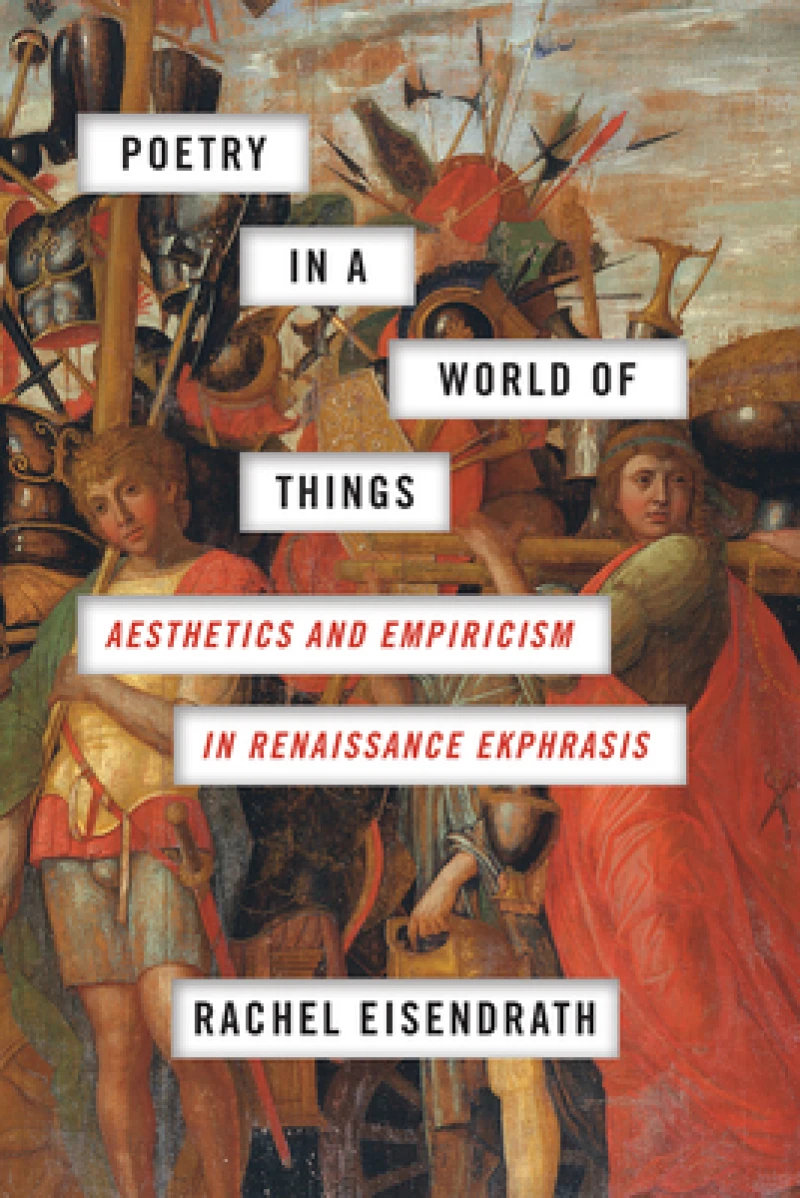
Poetry in a World of Things : Aesthetics and Empiricism in Renaissance Ekphrasis
Book Details
Format
Paperback / Softback
ISBN-10
022651661X
ISBN-13
9780226516615
Publisher
The University of Chicago Press
Imprint
University of Chicago Press
Country of Manufacture
US
Country of Publication
GB
Publication Date
Apr 6th, 2018
Print length
208 Pages
Weight
320 grams
Dimensions
15.30 x 22.80 x 1.80 cms
Ksh 4,800.00
Werezi Extended Catalogue
0 in stock
Delivery Location
Delivery fee: Select location
Secure
Quality
Fast
We have become used to looking at art from a stance of detachment. In order to be objective, we create a “mental space” between ourselves and the objects of our investigation, separating internal and external worlds. This detachment dates back to the early modern period, when researchers in a wide variety of fields tried to describe material objects as “things in themselves”—things, that is, without the admixture of imagination. Generations of scholars have heralded this shift as the Renaissance “discovery” of the observable world. In Poetry in a World of Things, Rachel Eisendrath explores how poetry responded to this new detachment by becoming a repository for a more complex experience of the world. The book focuses on ekphrasis, the elaborate literary description of a thing, as a mode of resistance to this new empirical objectivity. Poets like Petrarch, Spenser, Marlowe, and Shakespeare crafted highly artful descriptions that recovered the threatened subjective experience of the material world. In so doing, these poets reflected on the emergence of objectivity itself as a process that was often darker and more painful than otherwise acknowledged. This highly original book reclaims subjectivity as a decidedly poetic and human way of experiencing the material world and, at the same time, makes a case for understanding art objects as fundamentally unlike any other kind of objects.
Get Poetry in a World of Things by at the best price and quality guaranteed only at Werezi Africa's largest book ecommerce store. The book was published by The University of Chicago Press and it has pages.

