
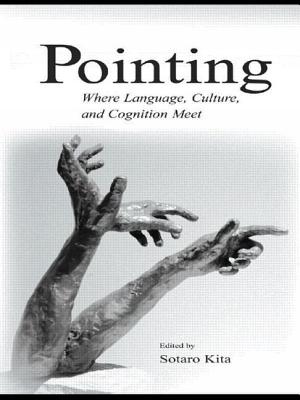
Pointing : Where Language, Culture, and Cognition Meet
Book Details
Format
Paperback / softback
ISBN-10
0415650895
ISBN-13
9780415650892
Publisher
Taylor & Francis Ltd
Imprint
Psychology Press Ltd
Country of Manufacture
GB
Country of Publication
GB
Publication Date
Oct 23rd, 2013
Print length
347 Pages
Weight
482 grams
Dimensions
22.90 x 15.20 x 1.90 cms
KSh 11,000.00
Currently unavailable
0 in stock
Delivery Location
Delivery fee: Select location
Secure
Quality
Fast
Pointing has captured the interest of scholars from various fields who study communication. However, ideas and findings have been scattered across diverse publications in different disciplines, and opportunities for interdisciplinary exchange have been very limited. The editor's aim is to provide an arena for such exchange by bringing together papers on pointing gestures from disciplines, such as developmental psychology, psycholinguistics, sign-language linguistics, linguistic anthropology, conversational analysis, and primatology. Questions raised by the editors include: *Do chimpanzees produce and comprehend pointing gestures in the same way as humans? *What are cross-cultural variations of pointing gestures? *In what sense are pointing gestures human universal? *What is the relationship between the development of pointing and language in children? *What linguistic roles do pointing gestures play in signed language? *Why do speakers sometimes point to seemingly empty space in front of them during conversation? *How do pointing gestures contribute to the unfolding of face-to-face interaction that involves objects in the environment? *What are the semiotic processes that relate what is pointed at and what is actually "meant" by the pointing gesture (the relationship between the two are often not as simple as one might think)? *Do pointing gestures facilitate the production of accompanying speech? The volume can be used as a required text in a course on gestural communication with multidisciplinary perspectives. It can also be used as a supplemental text in an advanced undergraduate or graduate course on interpersonal communication, cross-cultural communication, language development, and psychology of language.
Pointing has captured the interest of scholars from various fields who study communication. However, ideas and findings have been scattered across diverse publications in different disciplines, and opportunities for interdisciplinary exchange have been very limited. The editor''s aim is to provide an arena for such exchange by bringing together papers on pointing gestures from disciplines, such as developmental psychology, psycholinguistics, sign-language linguistics, linguistic anthropology, conversational analysis, and primatology.
Questions raised by the editors include:
*Do chimpanzees produce and comprehend pointing gestures in the same way as humans?
*What are cross-cultural variations of pointing gestures?
*In what sense are pointing gestures human universal?
*What is the relationship between the development of pointing and language in children?
*What linguistic roles do pointing gestures play in signed language?
*Why do speakers sometimes point to seemingly empty space in front of them during conversation?
*How do pointing gestures contribute to the unfolding of face-to-face interaction that involves objects in the environment?
*What are the semiotic processes that relate what is pointed at and what is actually "meant" by the pointing gesture (the relationship between the two are often not as simple as one might think)?
*Do pointing gestures facilitate the production of accompanying speech?
The volume can be used as a required text in a course on gestural communication with multidisciplinary perspectives. It can also be used as a supplemental text in an advanced undergraduate or graduate course on interpersonal communication, cross-cultural communication, language development, and psychology of language.
Questions raised by the editors include:
*Do chimpanzees produce and comprehend pointing gestures in the same way as humans?
*What are cross-cultural variations of pointing gestures?
*In what sense are pointing gestures human universal?
*What is the relationship between the development of pointing and language in children?
*What linguistic roles do pointing gestures play in signed language?
*Why do speakers sometimes point to seemingly empty space in front of them during conversation?
*How do pointing gestures contribute to the unfolding of face-to-face interaction that involves objects in the environment?
*What are the semiotic processes that relate what is pointed at and what is actually "meant" by the pointing gesture (the relationship between the two are often not as simple as one might think)?
*Do pointing gestures facilitate the production of accompanying speech?
The volume can be used as a required text in a course on gestural communication with multidisciplinary perspectives. It can also be used as a supplemental text in an advanced undergraduate or graduate course on interpersonal communication, cross-cultural communication, language development, and psychology of language.
Get Pointing by Sotaro Kita at the best price and quality guaranteed only at Werezi Africa's largest book ecommerce store. The book was published by Taylor & Francis Ltd and it has 347 pages.
Customers Who Bought This Also Bought

The Perks of Being a Bookworm
KSh 4,500.00
Semiotics and the Philosophy of Language
KSh 3,400.00

Chinese Children''s Reading Acquisition
KSh 16,200.00

New Trends in Language Acquisition Within the Generative Perspective
KSh 21,600.00

Vocabulary Studies in First and Second Language Acquisition
KSh 18,000.00

Improving the Emotional Intelligence of Translators
KSh 10,800.00
Phonology and Language Use
KSh 18,900.00

Engaging Children in Applied Linguistics Research
KSh 17,100.00

Optimality Theory and Pragmatics
KSh 8,100.00

Meaning
KSh 1,800.00

Nonverbal Steps to the Origins of Language
KSh 7,900.00

Active Learning from Infancy to Childhood
KSh 21,600.00
More in This Genre
The Perks of Being a Bookworm
KSh 4,500.00
Semiotics and the Philosophy of Language
KSh 3,400.00
Chinese Children''s Reading Acquisition
KSh 16,200.00
New Trends in Language Acquisition Within the Generative Perspective
KSh 21,600.00
Vocabulary Studies in First and Second Language Acquisition
KSh 18,000.00
Improving the Emotional Intelligence of Translators
KSh 10,800.00
