
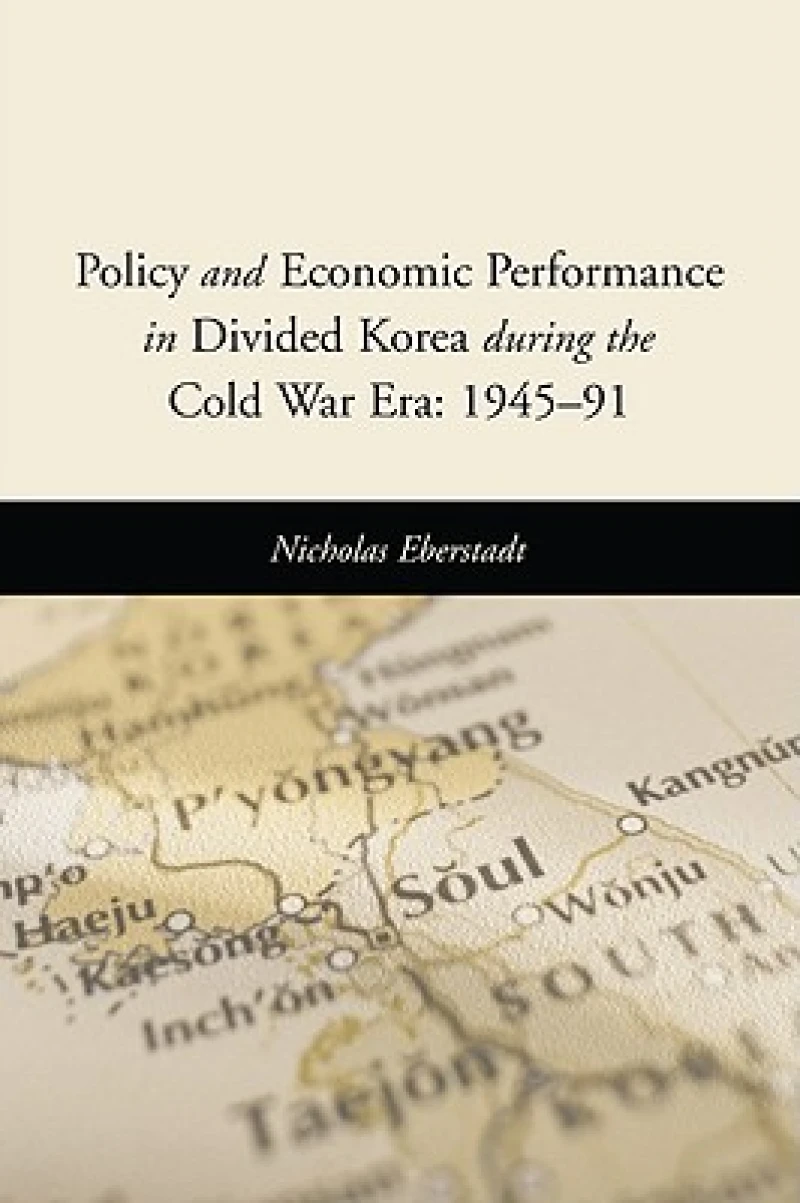
Policy and Economic Performance in Divided Korea during the Cold War Era: 1945-91
Book Details
Format
Paperback / Softback
ISBN-10
0844742740
ISBN-13
9780844742748
Publisher
AEI Press
Imprint
AEI Press
Country of Manufacture
GB
Country of Publication
GB
Publication Date
Mar 16th, 2010
Print length
340 Pages
Weight
504 grams
Dimensions
15.30 x 22.90 x 2.70 cms
Ksh 4,800.00
Re-Printing
0 in stock
Delivery Location
Delivery fee: Select location
Secure
Quality
Fast
The Korean peninsula during the Cold War provided a cruel but historically unparalleled real-world "experiment" in the relationship between polity and material advance: an ethnically and culturally homogenous nation was, in 1945, suddenly divided by an arbitrary boundary line and then subjected to two radically different and adversarial political economies for successive decades on end. Assessing the competition between the North and South Korean economies from partition to the end of the Soviet era, Nicholas Eberstadt argues that the storyline is not quite as simple as the now-prevailing narrative suggests (that centrally-planned economies are doomed to fail against market-oriented alternatives). Rather, he suggests, the race for material progress was just that: a race, the results of which were far from preordained at the outset. In Policy and Economic Performance in Divided Korea during the Cold War Era: 1945-91, Eberstadt presents an impressive compilation of hard-to-find comparative data on economic performance for the Democratic People's Republic of Korea (DPRK, or North Korea) and the Republic of Korea (ROK, or South Korea) over two critical generations. By a number of indicators, Eberstadt argues, Kim Il Sung's North Korea actually outperformed South Korea for much of this period-not only in the years immediately following partition, but perhaps also into the 1970s. To explain these surprising results, Eberstadt details the impact of government policies on the course of growth of both economies and offers some unorthodox observations about material performance under these two contending polities. He finds that prevailing economic development theory on such issues as planned-versus- market economies, military burden, and the relationship between material advance and poverty, may require reexamination in light of the experience of the two Koreas between partition and the end of the Cold War.
The Korean peninsula during the Cold War provided a cruel but historically unparalleled real-world “experiment” in the relationship between polity and material advance: an ethnically and culturally homogenous nation was, in 1945, suddenly divided by an arbitrary boundary line and then subjected to two radically different and adversarial political economies for successive decades on end. Assessing the competition between the North and South Korean economies from partition to the end of the Soviet era, Nicholas Eberstadt argues that the storyline is not quite as simple as the now-prevailing narrative suggests (that centrally-planned economies are doomed to fail against market-oriented alternatives). Rather, he suggests, the race for material progress was just that: a race, the results of which were far from preordained at the outset. In Policy and Economic Performance in Divided Korea during the Cold War Era: 1945–91, Eberstadt presents an impressive compilation of hard-to-find comparative data on economic performance for the Democratic People’s Republic of Korea (DPRK, or North Korea) and the Republic of Korea (ROK, or South Korea) over two critical generations. By a number of indicators, Eberstadt argues, Kim Il Sung’s North Korea actually outperformed South Korea for much of this period—not only in the years immediately following partition, but perhaps also into the 1970s. To explain these surprising results, Eberstadt details the impact of government policies on the course of growth of both economies and offers some unorthodox observations about material performance under these two contending polities. He finds that prevailing economic development theory on such issues as planned-versus- market economies, military burden, and the relationship between material advance and poverty, may require reexamination in light of the experience of the two Koreas between partition and the end of the Cold War.
Get Policy and Economic Performance in Divided Korea during the Cold War Era: 1945-91 by at the best price and quality guaranteed only at Werezi Africa's largest book ecommerce store. The book was published by AEI Press and it has pages.

