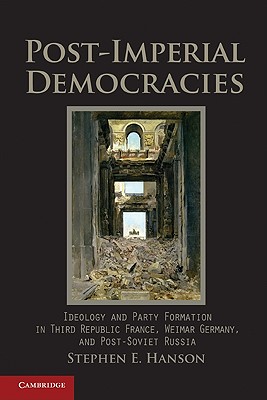
Post-Imperial Democracies : Ideology and Party Formation in Third Republic France, Weimar Germany, and Post-Soviet Russia
Book Details
Format
Hardback
Book Series
Cambridge Studies in Comparative Politics
ISBN-10
0521883512
ISBN-13
9780521883511
Publisher
Cambridge University Press
Imprint
Cambridge University Press
Country of Manufacture
US
Country of Publication
GB
Publication Date
Jul 5th, 2010
Print length
306 Pages
Weight
542 grams
Dimensions
15.90 x 23.50 x 2.30 cms
Product Classification:
European historyPolitics & governmentComparative politics
KSh 8,750.00
Currently unavailable
0 in stock
Delivery Location
Delivery fee: Select location
Secure
Quality
Fast
This book examines the causal impact of ideology through a comparative-historical analysis of three cases of 'post-imperial democracy': the early Third Republic in France (1870–86); the Weimar Republic in Germany (1918–34); and post-Soviet Russia (1992–2008).
This book examines the causal impact of ideology through a comparative-historical analysis of three cases of ''post-imperial democracy'': the early Third Republic in France (1870–86); the Weimar Republic in Germany (1918–34); and post-Soviet Russia (1992–2008). Hanson argues that political ideologies are typically necessary for the mobilization of enduring, independent national party organizations in uncertain democracies. By presenting an explicit and desirable picture of the political future, successful ideologues induce individuals to embrace a long-run strategy of cooperation with other converts. When enough new converts cooperate in this way, it enables sustained collective action to defend and extend party power. Successful party ideologies thus have the character of self-fulfilling prophecies: by portraying the future polity as one organized to serve the interests of those loyal to specific ideological principles, they help to bring political organizations centered on these principles into being.
Get Post-Imperial Democracies by Stephen E. Hanson at the best price and quality guaranteed only at Werezi Africa's largest book ecommerce store. The book was published by Cambridge University Press and it has 306 pages.
Customers Who Bought This Also Bought

Age of Revolutions
KSh 2,350.00

Eichmann in Jerusalem
KSh 2,350.00

Trouble With Being Born
KSh 2,000.00

Hiroshima
KSh 2,000.00

Freedom
KSh 6,300.00

Holocaust
KSh 2,700.00
The History of the Peloponnesian War
KSh 2,700.00
Annals
KSh 2,350.00
Greek Lives
KSh 2,150.00

Sleepwalkers
KSh 3,400.00

Napoleon The Great
KSh 3,600.00

Diary of a Young Girl
KSh 1,800.00