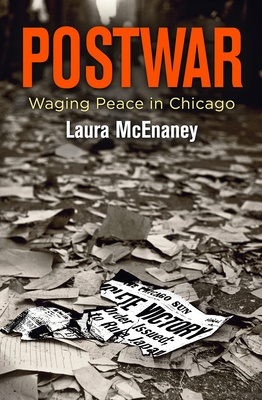
Postwar : Waging Peace in Chicago
Book Details
Delivery Location
Delivery fee: Select location
When World War II ended, Americans celebrated a military victory abroad, but the meaning of peace at home was yet to be defined. From roughly 1943 onward, building a postwar society became the new national project, and every interest group involved in the war effort-from business leaders to working-class renters-held different visions for the war''s aftermath. In Postwar, Laura McEnaney plumbs the depths of this period to explore exactly what peace meant to a broad swath of civilians, including apartment dwellers, single women and housewives, newly freed Japanese American internees, African American migrants, and returning veterans. In her fine-grained social history of postwar Chicago, McEnaney puts ordinary working-class people at the center of her investigation.
What she finds is a working-class war liberalism-a conviction that the wartime state had taken things from people, and that the postwar era was about reclaiming those things with the state''s help. McEnaney examines vernacular understandings of the state, exploring how people perceived and experienced government in their lives. For Chicago''s working-class residents, the state was not clearly delineated. The local offices of federal agencies, along with organizations such as the Travelers Aid Society and other neighborhood welfare groups, all became what she calls the state in the neighborhood, an extension of government to serve an urban working class recovering from war. Just as they had made war, the urban working class had to make peace, and their requests for help, large and small, constituted early dialogues about the role of the state during peacetime.
Postwar examines peace as its own complex historical process, a passage from conflict to postconflict that contained human struggles and policy dilemmas that would shape later decades as fatefully as had the war.
Get Postwar by Laura McEnaney at the best price and quality guaranteed only at Werezi Africa's largest book ecommerce store. The book was published by University of Pennsylvania Press and it has 288 pages.
Customers Who Bought This Also Bought
Crusade for Justice – The Autobiography of Ida B. Wells, Second Edition
KSh 4,050.00

Killers of the Flower Moon
KSh 2,000.00
Warmth of Other Suns
KSh 3,050.00
Frederick Douglass
KSh 3,350.00
107 Days
KSh 4,500.00

Second Treatise of Government – Norton Library
KSh 1,600.00
Tuesdays With Morrie
KSh 2,000.00
My Bondage and My Freedom
KSh 1,600.00

Hidden Figures
KSh 2,000.00
America, América
KSh 3,650.00
Holding the Line
KSh 2,000.00
Nuclear Folly
KSh 3,050.00