
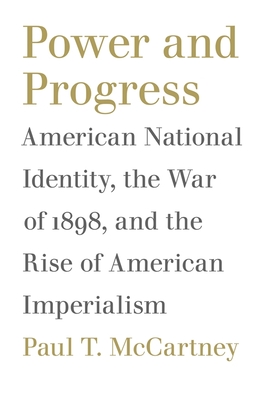
Power and Progress : American National Identity, the War of 1898, and the Rise of American Imperialism
Book Details
Format
Hardback
Book Series
Political Traditions in Foreign Policy Series
ISBN-10
0807131148
ISBN-13
9780807131145
Publisher
Louisiana State University Press
Imprint
Louisiana State University Press
Country of Manufacture
US
Country of Publication
GB
Publication Date
Feb 1st, 2006
Print length
384 Pages
Weight
333 grams
Dimensions
23.60 x 16.20 x 3.00 cms
KSh 7,200.00
Publisher Out of Stock
0 in stock
Delivery Location
Delivery fee: Select location
Secure
Quality
Fast
Presents a provocative case study of the Spanish-American War, exposing newfound dimensions to the relationship between American nationalism and US foreign policy. Two foreign-policy issues are at the centre of the analysis: the declaration of war against Spain in 1898 and the annexation of the Philippine Islands as part of the war's peace treaty.
In Power and Progress, Paul T. McCartney presents a provocative case study of the Spanish-American War, exposing newfound dimensions to the relationship between American nationalism and U.S. foreign policy. Two significant but distinct foreign-policy issues are at the center of McCartney's analysis: the declaration of war against Spain in 1898 and the annexation of the Philippine Islands as part of the war's peace treaty. According to McCartney, Americans were very explicitly and self-consciously expanding their nation's sense of mission in making these two foreign-policy decisions. They drew upon a cultural identity forged from racist, religious, and liberal-democratic characteristics to guide the United States into the uncharted waters of international prominence. What America did abroad they emphatically framed in terms of what they believed America to be. Foreign policy, McCartney argues, provided a concrete focus for this sense of mission on the world stage and played a marked role in shaping the contours and substance of American nationalism itself.
Power and Progress provides the first intensive look at how the idea of American mission has influenced the conduct of U.S. foreign policy, lending fresh insight into a transformative moment in the development of both U.S. foreign policy and national identity. It contributes measurably to our understanding of the cultural sources of American foreign policy and thus serves as a partial corrective to studies that overemphasise economic motives.
Power and Progress provides the first intensive look at how the idea of American mission has influenced the conduct of U.S. foreign policy, lending fresh insight into a transformative moment in the development of both U.S. foreign policy and national identity. It contributes measurably to our understanding of the cultural sources of American foreign policy and thus serves as a partial corrective to studies that overemphasise economic motives.
Get Power and Progress by Paul T. McCartney at the best price and quality guaranteed only at Werezi Africa's largest book ecommerce store. The book was published by Louisiana State University Press and it has 384 pages.
Customers Who Bought This Also Bought

Crusade for Justice – The Autobiography of Ida B. Wells, Second Edition
KSh 4,050.00

Killers of the Flower Moon
KSh 2,000.00

Warmth of Other Suns
KSh 3,050.00

Frederick Douglass
KSh 3,350.00
107 Days
KSh 4,500.00

Second Treatise of Government – Norton Library
KSh 1,600.00

Tuesdays With Morrie
KSh 2,000.00
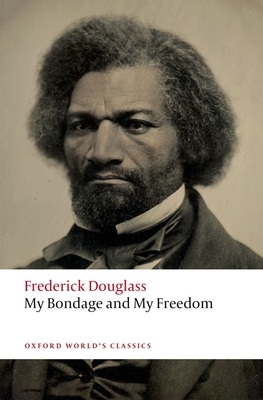
My Bondage and My Freedom
KSh 1,600.00

Hidden Figures
KSh 2,000.00

America, América
KSh 3,650.00

Holding the Line
KSh 2,000.00
Nuclear Folly
KSh 3,050.00
