
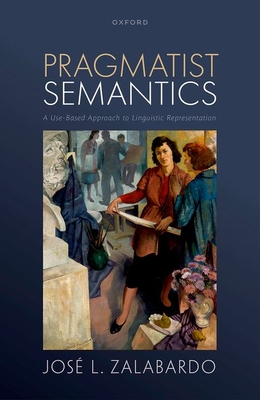
Pragmatist Semantics : A Use-Based Approach to Linguistic Representation
Book Details
Format
Hardback
ISBN-10
0192874756
ISBN-13
9780192874757
Publisher
Oxford University Press
Imprint
Oxford University Press
Country of Manufacture
GB
Country of Publication
GB
Publication Date
May 4th, 2023
Print length
250 Pages
Weight
518 grams
Dimensions
16.20 x 24.30 x 2.20 cms
KSh 12,950.00
Currently unavailable
0 in stock
Delivery Location
Delivery fee: Select location
Secure
Quality
Fast
José L. Zalabardo defends a pragmatist account of the meaning of central semantic discourses—ascriptions of truth, of propositional attitudes, and of meanings. On Zalabardo's account, what makes the sentences of these discourses have the meanings they have are the procedures that regulate their acceptance and rejection.
José L. Zalabardo defends a pragmatist account of what grounds the meaning of central semantic discourses—ascriptions of truth, of propositional attitudes, and of meanings. He argues that it is the procedures that regulate acceptance and rejection that give the sentences of these discourses their meanings, and explores the application of the pragmatist template to ethical discourse.The pragmatist approach is presented as an alternative to representationalist accounts of the meaning grounds of declarative sentences, according to which a sentence has the meaning it has as a result of links with the bits of the world that it purports to represent. Zalabardo develops a version of the open-question argument to support the claim that the meaning grounds of the discourses he focuses on cannot receive representationalist accounts. It is generally assumed that a declarative sentence cannot perform the function of representing the world unless it has a representationalist meaning ground. Zalabardo rejects this assumption, arguing that sentences with pragmatist meaning grounds can represent the world in exactly the same sense that sentences with representationalist meaning grounds do. This requires that there are states of affairs that the target sentences represent as obtaining, and Zalabardo develops an account of the nature of the states of affairs that can play this role for sentences with pragmatist meaning grounds.Pragmatist Semantics concludes by developing the suggestion that the meaning grounds of all our representational discourses might be ultimately pragmatist.
Get Pragmatist Semantics by Prof Jose L. Zalabardo at the best price and quality guaranteed only at Werezi Africa's largest book ecommerce store. The book was published by Oxford University Press and it has 250 pages.
Customers Who Bought This Also Bought

Recognising the Stranger
KSh 1,800.00
The Origin of Language
KSh 4,500.00
Sharing Thoughts
KSh 17,000.00

An Inquiry Into Meaning and Truth
KSh 3,750.00
Semiotics and the Philosophy of Language
KSh 3,400.00
An Introduction to Logic
KSh 6,650.00

Walker Percy''s Search for Community
KSh 5,950.00
Film Figures
KSh 16,450.00

The Tacit Dimensions of Language and Logic
KSh 15,800.00

Metaphors in Action
KSh 21,600.00
Frontiers in Semiotics
KSh 3,000.00

A Theory of Death
KSh 11,900.00
