
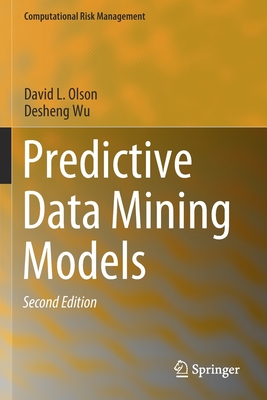
Book Details
Format
Paperback / softback
Book Series
Computational Risk Management
ISBN-10
9811396663
ISBN-13
9789811396663
Edition
Second Edition 2020
Publisher
Springer Verlag, Singapore
Imprint
Springer Verlag, Singapore
Country of Manufacture
GB
Country of Publication
GB
Publication Date
Aug 21st, 2020
Print length
125 Pages
KSh 12,600.00
Currently unavailable
0 in stock
Delivery Location
Delivery fee: Select location
Secure
Quality
Fast
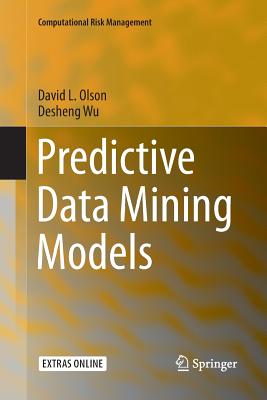
This book provides an overview of predictive methods demonstrated by open source software modeling with Rattle (R’) and WEKA. Chapter 3 covers fundamentals time series modeling tools, and Chapter 4 provides demonstration of multiple regression modeling.
This book provides an overview of predictive methods demonstrated by open source software modeling with Rattle (R'') and WEKA. Knowledge management involves application of human knowledge (epistemology) with the technological advances of our current society (computer systems) and big data, both in terms of collecting data and in analyzing it. We see three types of analytic tools. Descriptive analytics focus on reports of what has happened. Predictive analytics extend statistical and/or artificial intelligence to provide forecasting capability. It also includes classification modeling. Prescriptive analytics applies quantitative models to optimize systems, or at least to identify improved systems. Data mining includes descriptive and predictive modeling. Operations research includes all three. This book focuses on prescriptive analytics.
The book seeks to provide simple explanations and demonstration of some descriptive tools. This second edition provides more examples of big data impact, updates the content on visualization, clarifies some points, and expands coverage of association rules and cluster analysis. Chapter 1 gives an overview in the context of knowledge management. Chapter 2 discusses some basic data types. Chapter 3 covers fundamentals time series modeling tools, and Chapter 4 provides demonstration of multiple regression modeling. Chapter 5 demonstrates regression tree modeling. Chapter 6 presents autoregressive/integrated/moving average models, as well as GARCH models. Chapter 7 covers the set of data mining tools used in classification, to include special variants support vector machines, random forests, and boosting.
Models are demonstrated using business related data. The style of the book is intended to be descriptive, seeking to explain how methods work, with some citations, but without deep scholarly reference. The data sets and software are all selected for widespread availability and access by any reader with computer links.
Get Predictive Data Mining Models by David L. Olson, Desheng Wu at the best price and quality guaranteed only at Werezi Africa's largest book ecommerce store. The book was published by Springer Verlag, Singapore and it has 125 pages.
Customers Who Bought This Also Bought

Skin in the Game
KSh 2,350.00

The Cambridge Handbook of Compliance
KSh 9,550.00

The Global Geography of Long-Term Projected Macroeconomic Damages from Chronic Physical Risk
KSh 9,900.00

Risk Management in Post-Trust Society
KSh 16,200.00

Credit Guarantee Institutions and SME Finance
KSh 16,200.00

Options for Risk-Free Portfolios
KSh 9,900.00

Credit-Risk Modelling
KSh 10,800.00

Applied Reliability, Usability, and Quality for Engineers
KSh 26,300.00

18th International Probabilistic Workshop
KSh 32,400.00

Risk Management in East Asia
KSh 21,600.00

Ganzheitliches Chancen- und Risikomanagement
KSh 8,100.00

Liquidity
KSh 23,400.00
More by David L. Olson, Desheng Wu
Descriptive Data Mining
KSh 18,000.00
Deskriptives Data-Mining
KSh 13,500.00
Enterprise Risk Management Models
KSh 13,500.00
Predictive Data Mining Models
KSh 14,400.00

Pandemic Risk Management in Operations and Finance
KSh 13,500.00
Data Mining Models
KSh 3,350.00

Data Mining and Analytics in Healthcare Management
KSh 9,900.00
Introduction to Business Analytics
KSh 4,550.00
Digitising Enterprise in an Information Age
KSh 22,500.00

Core Concepts of Project Management
KSh 4,150.00
Data Mining Models
KSh 3,350.00
Descriptive Data Mining
KSh 23,400.00
More in This Genre
Skin in the Game
KSh 2,350.00
The Cambridge Handbook of Compliance
KSh 9,550.00
The Global Geography of Long-Term Projected Macroeconomic Damages from Chronic Physical Risk
KSh 9,900.00
Risk Management in Post-Trust Society
KSh 16,200.00
Credit Guarantee Institutions and SME Finance
KSh 16,200.00
Options for Risk-Free Portfolios
KSh 9,900.00
