
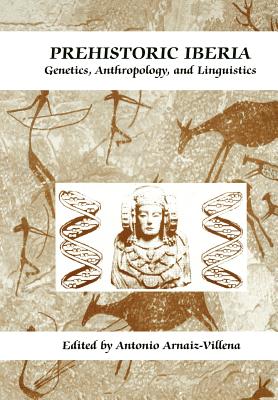
Prehistoric Iberia : Genetics, Anthropology, and Linguistics
Softcover reprint of the original 1st ed. 2000
Book Details
Format
Paperback / softback
ISBN-10
1461369002
ISBN-13
9781461369004
Edition
Softcover reprint of the original 1st ed. 2000
Publisher
Springer-Verlag New York Inc.
Imprint
Springer-Verlag New York Inc.
Country of Manufacture
US
Country of Publication
GB
Publication Date
Oct 3rd, 2012
Print length
252 Pages
Weight
512 grams
Dimensions
25.40 x 17.80 x 1.80 cms
KSh 16,200.00
Currently unavailable
0 in stock
Delivery Location
Delivery fee: Select location
Secure
Quality
Fast
Basque language translation into Spanish has been the key for relating most Mediterranean extinct languages. This was the "old language" that was slowly substituted by Eurasian languages starting approximately after the Bronze Age (or 2,000 years BC).
The symposium "Prehistoric Iberia: genetics, anthropology and linguistics" was held in the Circulo de Bellas Artes, Madrid on 16th -17th November 1998. The idea was bringing together specialists who could address not clearly resolved historic and prehistoric issues regarding ancient Iberian and Mediterranean populations, following a multidisciplinary approach. This was necessary in the light of the new bulk of genetic, archeological and linguistic data obtained with the new DNA technology and the recent discoverings in the other fields. Genes may now be easily studied in populations, particularly HLA genes and markers of the mitochondrial DNA and the Y chromosome. Basques, Iberians, North Africans, Berbers (Imazighen) and Mediterraneans have presently been widely studied. The genetic emerging picture is that Mediterraneans are closely related from West (Basque, Iberians, Berbers) to East (Jews, Lebanese, Cretans); however, Greeks are outliers in all the analyses done by using HLA genes. Anthropologists and archeologists showed how there was no people substitution during the revolutionary Mesolithic-Neolithic transition; in addition, cultural relationships were found between Iberia and predinastic Egypt (EI Badari culture). Basque language translation into Spanish has been the key for relating most Mediterranean extinct languages. The Usko-Mediterranean languages were once spoken in a wide African and European area, which also included parts of Asia. This was the "old language" that was slowly substituted by Eurasian languages starting approximately after the Bronze Age (or 2,000 years BC).
Get Prehistoric Iberia by Antonio Arnaiz-Villena at the best price and quality guaranteed only at Werezi Africa's largest book ecommerce store. The book was published by Springer-Verlag New York Inc. and it has 252 pages.
Customers Who Bought This Also Bought
Servus
KSh 4,500.00

Memoirs of the Marquis of Torcy, Secretary of State to Lewis XIV. Containing the history of the negotiations from the Treaty of Ryswic to the Peace of Utrecht. Translated from the French. ... Volume 1 of 2
KSh 4,050.00
Memoirs of the Marquis of Torcy, Secretary of State to Lewis XIV. Containing the history of the negotiations from the Treaty of Ryswic to the Peace of Utrecht. Translated from the French. ... Volume 2 of 2
KSh 3,750.00

The Biggest Prison on Earth
KSh 2,350.00
The Stated Motivations for the Early Islamic Expansion (622–641)
KSh 16,250.00
Introducing Anthropology – What Makes Us Human?
KSh 5,250.00
Rousseau: The Social Contract and Other Later Political Writings
KSh 4,500.00
The History of Kamtschatka, and the Kurilski Islands, with the Countries Adjacent; Illustrated with Maps and Cuts. Published at Petersbourg in the Russian Language, ... and Translated Into English by James Grieve, M.D.
KSh 3,650.00

The Persians – Lost Civilizations
KSh 2,700.00

Edward I and Wales, 1254-1307
KSh 4,500.00

Plantagenet Princes
KSh 2,350.00
St. Catherines
KSh 3,700.00
More in This Genre
Servus
KSh 4,500.00
Memoirs of the Marquis of Torcy, Secretary of State to Lewis XIV. Containing the history of the negotiations from the Treaty of Ryswic to the Peace of Utrecht. Translated from the French. ... Volume 1 of 2
KSh 4,050.00
Memoirs of the Marquis of Torcy, Secretary of State to Lewis XIV. Containing the history of the negotiations from the Treaty of Ryswic to the Peace of Utrecht. Translated from the French. ... Volume 2 of 2
KSh 3,750.00
The Biggest Prison on Earth
KSh 2,350.00
The Stated Motivations for the Early Islamic Expansion (622–641)
KSh 16,250.00
Introducing Anthropology – What Makes Us Human?
KSh 5,250.00
