
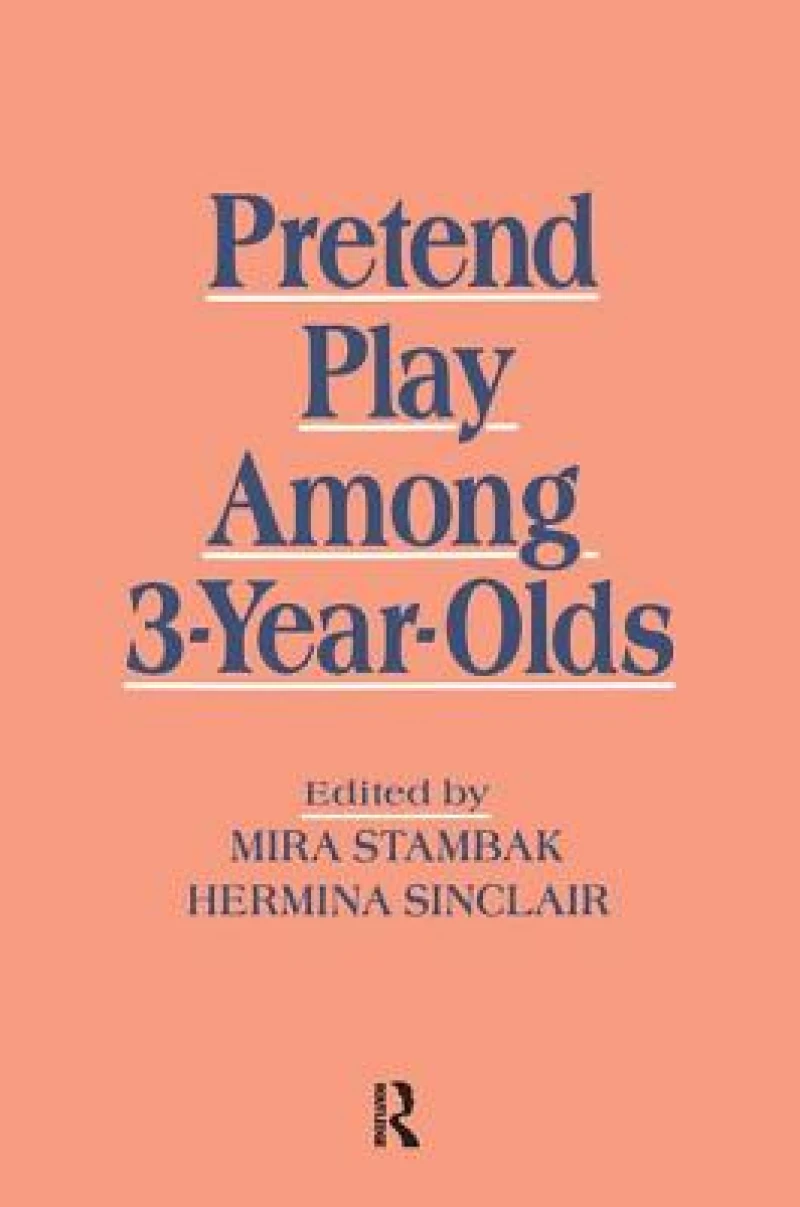
Pretend Play Among 3-year-olds
Book Details
Format
Paperback / Softback
ISBN-10
1138876364
ISBN-13
9781138876361
Publisher
Taylor & Francis Ltd
Imprint
Psychology Press Ltd
Country of Manufacture
GB
Country of Publication
GB
Publication Date
Jan 21st, 2019
Print length
144 Pages
Weight
216 grams
Dimensions
15.30 x 22.70 x 1.00 cms
Product Classification:
Child & developmental psychologyCognition & cognitive psychology
Ksh 9,350.00
Werezi Extended Catalogue
0 in stock
Delivery Location
Delivery fee: Select location
Secure
Quality
Fast
translated by Hermina and Morris Sinclair This book was written by a group of researchers with a common theoretical-constructivist-framework and using the same methods of naturalistic observation and data analysis. They considered that collective pretend play would provide excellent opportunities for understanding young children's thinking, especially when play arose spontaneously in a familiar environment. In such play, children often manifest types of knowledge that cannot be captured through experimental work or by observation in adult-devised situations. Spontaneous play brings out children's own preoccupations, their know-how in negotiating with one another in order to make sustained play possible, their ability to construct coherent sequences, and their often surprising insight into adult behavior. Play sequences are reported in full and sometimes dramatic detail in each of the chapters. Different activities were elicited by different situations, though all were observed in the familiar environment of day-care centers. Different situations -- play with toys such as cups, spoons and dolls, with pieces of cloth, string and cardboard, with grass, pebbles and swings in the yard, or with hand-held puppets -- allow the authors to discover often unsuspected knowledge among three-year-olds: communicative, socio-affective, societal, and psycho-social. At the same time, the authors underline the similarity of the interactive construction processes. The data and their analyses provide a solid base for two of Piaget's theoretical arguments: peer interaction leads to collaborative processes at an early age, and collaboration leads to objective knowledge via the attribution of shared meanings to jointly constructed experiences.
translated by Hermina and Morris Sinclair
This book was written by a group of researchers with a common theoretical-constructivist-framework and using the same methods of naturalistic observation and data analysis. They considered that collective pretend play would provide excellent opportunities for understanding young children''s thinking, especially when play arose spontaneously in a familiar environment. In such play, children often manifest types of knowledge that cannot be captured through experimental work or by observation in adult-devised situations. Spontaneous play brings out children''s own preoccupations, their know-how in negotiating with one another in order to make sustained play possible, their ability to construct coherent sequences, and their often surprising insight into adult behavior.
Play sequences are reported in full and sometimes dramatic detail in each of the chapters. Different activities were elicited by different situations, though all were observed in the familiar environment of day-care centers. Different situations -- play with toys such as cups, spoons and dolls, with pieces of cloth, string and cardboard, with grass, pebbles and swings in the yard, or with hand-held puppets -- allow the authors to discover often unsuspected knowledge among three-year-olds: communicative, socio-affective, societal, and psycho-social. At the same time, the authors underline the similarity of the interactive construction processes.
The data and their analyses provide a solid base for two of Piaget''s theoretical arguments: peer interaction leads to collaborative processes at an early age, and collaboration leads to objective knowledge via the attribution of shared meanings to jointly constructed experiences.
This book was written by a group of researchers with a common theoretical-constructivist-framework and using the same methods of naturalistic observation and data analysis. They considered that collective pretend play would provide excellent opportunities for understanding young children''s thinking, especially when play arose spontaneously in a familiar environment. In such play, children often manifest types of knowledge that cannot be captured through experimental work or by observation in adult-devised situations. Spontaneous play brings out children''s own preoccupations, their know-how in negotiating with one another in order to make sustained play possible, their ability to construct coherent sequences, and their often surprising insight into adult behavior.
Play sequences are reported in full and sometimes dramatic detail in each of the chapters. Different activities were elicited by different situations, though all were observed in the familiar environment of day-care centers. Different situations -- play with toys such as cups, spoons and dolls, with pieces of cloth, string and cardboard, with grass, pebbles and swings in the yard, or with hand-held puppets -- allow the authors to discover often unsuspected knowledge among three-year-olds: communicative, socio-affective, societal, and psycho-social. At the same time, the authors underline the similarity of the interactive construction processes.
The data and their analyses provide a solid base for two of Piaget''s theoretical arguments: peer interaction leads to collaborative processes at an early age, and collaboration leads to objective knowledge via the attribution of shared meanings to jointly constructed experiences.
Get Pretend Play Among 3-year-olds by at the best price and quality guaranteed only at Werezi Africa's largest book ecommerce store. The book was published by Taylor & Francis Ltd and it has pages.

