
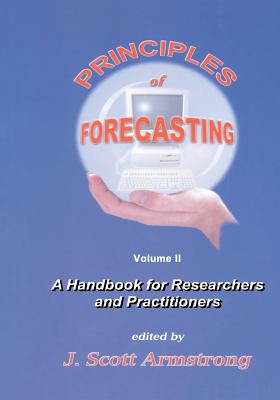
Principles of Forecasting : A Handbook for Researchers and Practitioners
New
Book Details
Format
Paperback / softback
ISBN-10
0792374010
ISBN-13
9780792374015
Edition
New
Publisher
Springer
Imprint
Springer
Country of Manufacture
GB
Country of Publication
GB
Publication Date
Jan 31st, 2002
Print length
850 Pages
Product Classification:
Business strategyManagement & management techniques
KSh 81,000.00
Currently unavailable
0 in stock
Delivery Location
Delivery fee: Select location
Secure
Quality
Fast
Principles of Forecasting: A Handbook for Researchers and Practitioners summarizes knowledge from experts and from empirical studies. Contributions were written by 40 leading experts in forecasting, and the 30 chapters cover all types of forecasting methods.
Principles of Forecasting: A Handbook for Researchers and Practitioners summarizes knowledge from experts and from empirical studies. It provides guidelines that can be applied in fields such as economics, sociology, and psychology. It applies to problems such as those in finance (How much is this company worth?), marketing (Will a new product be successful?), personnel (How can we identify the best job candidates?), and production (What level of inventories should be kept?).
The book is edited by Professor J. Scott Armstrong of the Wharton School, University of Pennsylvania. Contributions were written by 40 leading experts in forecasting, and the 30 chapters cover all types of forecasting methods. There are judgmental methods such as Delphi, role-playing, and intentions studies. Quantitative methods include econometric methods, expert systems, and extrapolation. Some methods, such as conjoint analysis, analogies, and rule-based forecasting, integrate quantitative and judgmental procedures. In each area, the authors identify what is known in the form of `if-then principles'', and they summarize evidence on these principles.
The project, developed over a four-year period, represents the first book to summarize all that is known about forecasting and to present it so that it can be used by researchers and practitioners. To ensure that the principles are correct, the authors reviewed one another''s papers. In addition, external reviews were provided by more than 120 experts, some of whom reviewed many of the papers. The book includes the first comprehensive forecasting dictionary.
The book is edited by Professor J. Scott Armstrong of the Wharton School, University of Pennsylvania. Contributions were written by 40 leading experts in forecasting, and the 30 chapters cover all types of forecasting methods. There are judgmental methods such as Delphi, role-playing, and intentions studies. Quantitative methods include econometric methods, expert systems, and extrapolation. Some methods, such as conjoint analysis, analogies, and rule-based forecasting, integrate quantitative and judgmental procedures. In each area, the authors identify what is known in the form of `if-then principles'', and they summarize evidence on these principles.
The project, developed over a four-year period, represents the first book to summarize all that is known about forecasting and to present it so that it can be used by researchers and practitioners. To ensure that the principles are correct, the authors reviewed one another''s papers. In addition, external reviews were provided by more than 120 experts, some of whom reviewed many of the papers. The book includes the first comprehensive forecasting dictionary.
Get Principles of Forecasting by J.S. Armstrong at the best price and quality guaranteed only at Werezi Africa's largest book ecommerce store. The book was published by Springer and it has 850 pages.
Customers Who Bought This Also Bought
Measure What Matters
KSh 2,700.00

Harvard Business Review Manager''s Handbook
KSh 4,150.00

Never Split the Difference
KSh 2,150.00

Ego is the Enemy
KSh 2,000.00

The Upside of Uncertainty
KSh 4,500.00

The Concise 33 Strategies of War
KSh 2,000.00
Turning the Flywheel
KSh 1,800.00
Turning Goals into Results
KSh 1,250.00

Built To Last
KSh 4,700.00
Prediction Machines
KSh 3,950.00

How Big Things Get Done
KSh 2,150.00
Noise
KSh 2,000.00
