
Cart 0
Principles of Gravitational Lensing
Click to zoom

Share this book

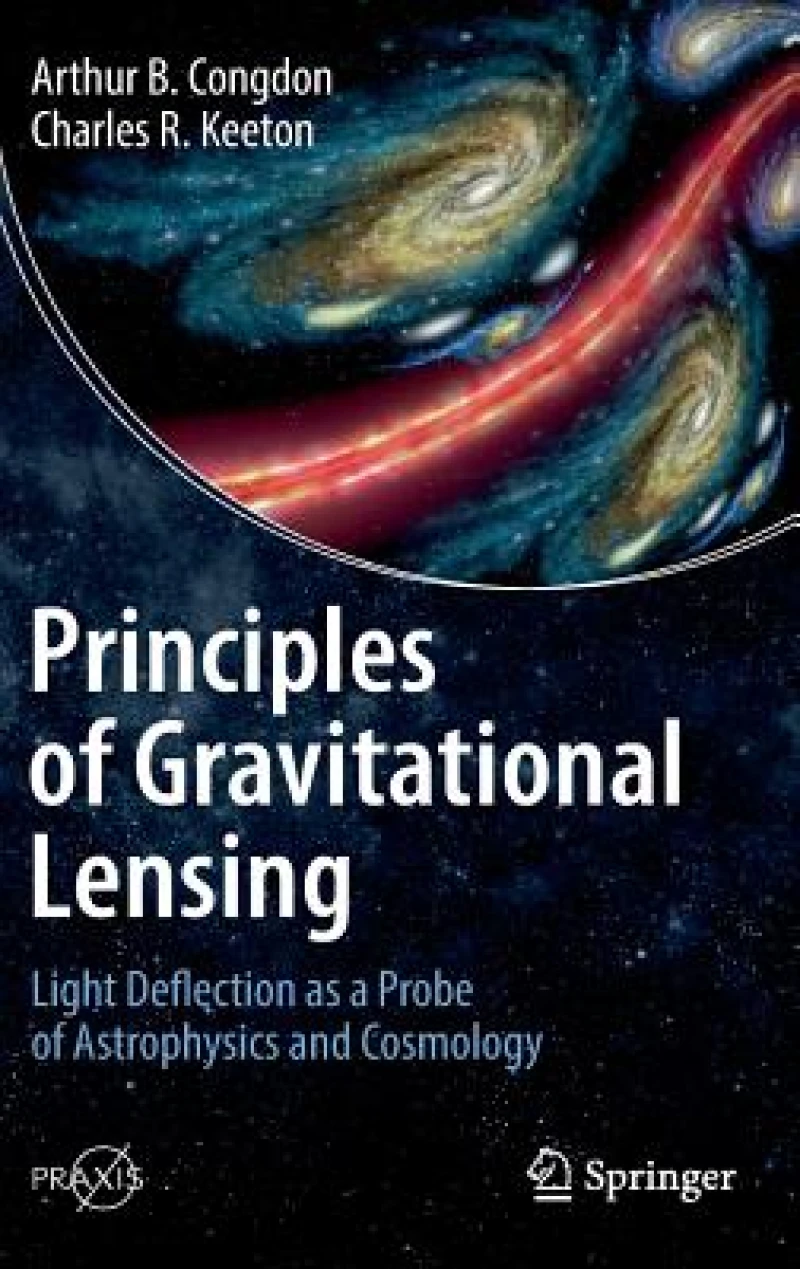
Principles of Gravitational Lensing : Light Deflection as a Probe of Astrophysics and Cosmology

2018 ed.

Book Details

Format Hardback or Cased Book
ISBN-10 3030021211
ISBN-13 9783030021214
Edition 2018 ed.
Publisher Springer Nature Switzerland AG
Imprint Springer Nature Switzerland AG
Country of Manufacture CH
Country of Publication GB
Publication Date Dec 12th, 2018
Print length 287 Pages
Weight 622 grams
Dimensions 24.30 x 16.40 x 1.90 cms
Ksh 16,200.00
Werezi Extended Catalogue Delivery in 28 days

Delivery Location

Delivery fee: Select location

Delivery in 28 days

Secure
Quality
Fast
This textbook provides an introduction to gravitational lensing, which has become an invaluable tool in modern astrophysics, with applications that range from finding planets orbiting distant stars to understanding how dark matter and dark energy conspired to form the cosmic structures we see today. Principles of Gravitational Lensing begins with Einstein’s prediction that gravity bends light, and shows how that fundamental idea has spawned a rich field of study over the past century. The gravitational deflection of light was first detected by Eddington during a solar eclipse in May 1919, launching Einstein and his theory of relativity into public view. Yet the possibility of using the phenomenon to unlock mysteries of the Universe seemed remote, given the technology of the day. Theoretical work was carried out sporadically over the next six decades, but only with the discovery of the system Q0957+561 in 1979 was gravitational lensing transformed from a curiosity ofgeneral relativity into a practical observational tool. This book describes how the three subfields known as strong lensing, weak lensing, and microlensing have grown independently but become increasingly intertwined. Drawing on their research experience, Congdon and Keeton begin with the basic physics of light bending, then present the mathematical foundations of gravitational lensing, building up to current research topics in a clear and systematic way. Relevant background material from physics and mathematics is included, making the book self-contained. The derivations and explanations are supplemented by exercises designed to help students master the theoretical concepts as well as the methods that drive current research. An extensive bibliography guides those wishing to delve more deeply into particular areas of interest. Principles of Gravitational Lensing is ideal for advanced students and seasoned researchers looking to penetrate this thriving subject and even contribute research of their own.

This textbook provides an introduction to gravitational lensing, which has become an invaluable tool in modern astrophysics, with applications that range from finding planets orbiting distant stars to understanding how dark matter and dark energy conspired to form the cosmic structures we see today. Principles of Gravitational Lensing begins with Einstein''s prediction that gravity bends light, and shows how that fundamental idea has spawned a rich field of study over the past century.

The gravitational deflection of light was first detected by Eddington during a solar eclipse in May 1919, launching Einstein and his theory of relativity into public view. Yet the possibility of using the phenomenon to unlock mysteries of the Universe seemed remote, given the technology of the day. Theoretical work was carried out sporadically over the next six decades, but only with the discovery of the system Q0957+561 in 1979 was gravitational lensing transformed from a curiosity of general relativity into a practical observational tool.

This book describes how the three subfields known as strong lensing, weak lensing, and microlensing have grown independently but become increasingly intertwined. Drawing on their research experience, Congdon and Keeton begin with the basic physics of light bending, then present the mathematical foundations of gravitational lensing, building up to current research topics in a clear and systematic way. Relevant background material from physics and mathematics is included, making the book self-contained.

The derivations and explanations are supplemented by exercises designed to help students master the theoretical concepts as well as the methods that drive current research. An extensive bibliography guides those wishing to delve more deeply into particular areas of interest. Principles of Gravitational Lensing is ideal for advanced students and seasoned researchers looking to penetrate this thriving subject and even contribute research of their own.


Get Principles of Gravitational Lensing by at the best price and quality guaranteed only at Werezi Africa's largest book ecommerce store. The book was published by Springer Nature Switzerland AG and it has pages.


Mind, Body, & Spirit

Price

Ksh 16,200.00

Shopping Cart

Africa largest book store

Sub Total:
Ebooks

Digital Library
Coming Soon

Our digital collection is currently being curated to ensure the best possible reading experience on Werezi. We'll be launching our Ebooks platform shortly.