
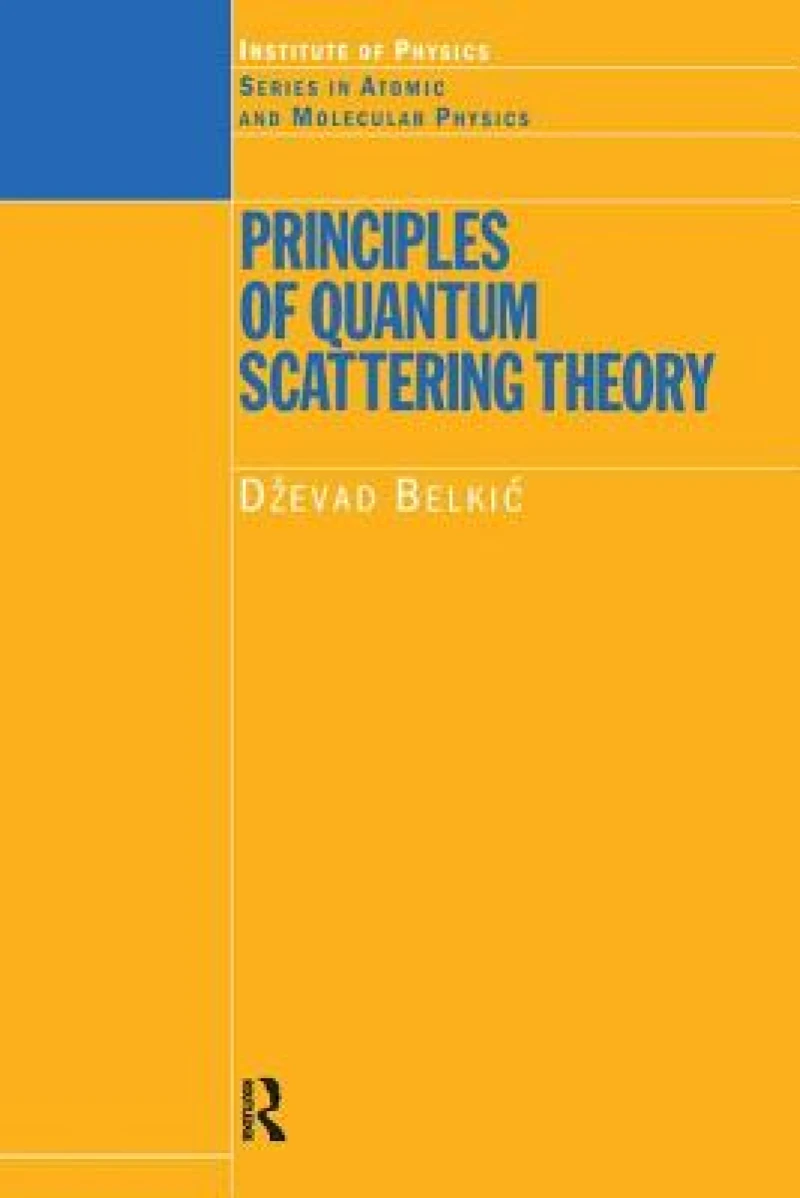
Principles of Quantum Scattering Theory
Book Details
Format
Hardback or Cased Book
Book Series
Series in Atomic Molecular Physics
ISBN-10
0750304960
ISBN-13
9780750304962
Publisher
Taylor & Francis Ltd
Imprint
Institute of Physics Publishing
Country of Manufacture
GB
Country of Publication
GB
Publication Date
Dec 1st, 2003
Print length
392 Pages
Weight
786 grams
Ksh 46,800.00
Re-Printing
0 in stock
Delivery Location
Delivery fee: Select location
Secure
Quality
Fast
Scattering is one of the most powerful methods used to study the structure of matter, and many of the most important breakthroughs in physics have been made by means of scattering. This book combines physical intuition and mathematical rigour to present various selected principles of quantum scattering theory.
Scattering is one of the most powerful methods used to study the structure of matter, and many of the most important breakthroughs in physics have been made by means of scattering. Nearly a century has passed since the first investigations in this field, and the work undertaken since then has resulted in a rich literature encompassing both experimental and theoretical results.
In scattering, one customarily studies collisions among nuclear, sub-nuclear, atomic or molecular particles, and as these are intrinsically quantum systems, it is logical that quantum mechanics is used as the basis for modern scattering theory. In Principles of Quantum Scattering Theory, the author judiciously combines physical intuition and mathematical rigour to present various selected principles of quantum scattering theory. As always in physics, experiment should be used to ultimately validate physical and mathematical modelling, and the author presents a number of exemplary illustrations, comparing theoretical and experimental cross sections in a selection of major inelastic ion-atom collisions at high non-relativistic energies.
Quantum scattering theory, one of the most beautiful theories in physics, is also very rich in mathematics. Principles of Quantum Scattering Theory is intended primarily for graduate physics students, but also for non-specialist physicists for whom the clarity of exposition should aid comprehension of these mathematical complexities.
In scattering, one customarily studies collisions among nuclear, sub-nuclear, atomic or molecular particles, and as these are intrinsically quantum systems, it is logical that quantum mechanics is used as the basis for modern scattering theory. In Principles of Quantum Scattering Theory, the author judiciously combines physical intuition and mathematical rigour to present various selected principles of quantum scattering theory. As always in physics, experiment should be used to ultimately validate physical and mathematical modelling, and the author presents a number of exemplary illustrations, comparing theoretical and experimental cross sections in a selection of major inelastic ion-atom collisions at high non-relativistic energies.
Quantum scattering theory, one of the most beautiful theories in physics, is also very rich in mathematics. Principles of Quantum Scattering Theory is intended primarily for graduate physics students, but also for non-specialist physicists for whom the clarity of exposition should aid comprehension of these mathematical complexities.
Get Principles of Quantum Scattering Theory by at the best price and quality guaranteed only at Werezi Africa's largest book ecommerce store. The book was published by Taylor & Francis Ltd and it has pages.

