
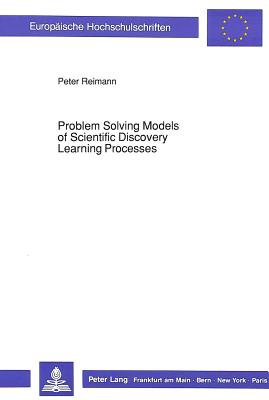
Problem Solving Models of Scientific Discovery Learning Processes
Book Details
Format
Paperback / softback
Book Series
European University Studies
ISBN-10
3631427093
ISBN-13
9783631427095
Publisher
Peter Lang GmbH
Imprint
Peter Lang GmbH
Country of Manufacture
GB
Country of Publication
GB
Publication Date
Mar 1st, 1990
Print length
204 Pages
Weight
320 grams
Dimensions
16.20 x 23.00 x 1.30 cms
Product Classification:
Educational psychology
KSh 7,900.00
Currently unavailable
0 in stock
Delivery Location
Delivery fee: Select location
Secure
Quality
Fast
Generation and testing of hypotheses are central aspects of the process of scientific discovery. In instructional contexts, students can acquire a basic understanding of these concepts by means of scientific discovery learning. In order to study the mechanisms that underly students'' ability to generalize from specific observations and to use these hypotheses to derive predictions, observations on students working in a computerized discovery learning environment for geometrical optics are analyzed. In addition, cognitive simulation programs taking the form of production systems are developed to capture the central aspects of students'' discovery learning strategies. These task-specific models are discussed within the framework of general computational theories of human inductive learning.
Get Problem Solving Models of Scientific Discovery Learning Processes by Peter Reimann at the best price and quality guaranteed only at Werezi Africa's largest book ecommerce store. The book was published by Peter Lang GmbH and it has 204 pages.
Customers Who Bought This Also Bought
Make It Stick – The Science of Successful Learning
KSh 5,200.00

The Perks of Being a Bookworm
KSh 4,500.00

Helping Children Succeed
KSh 3,050.00

Secondary Traumatic Stress in Teaching
KSh 5,750.00

Learning Without Lessons
KSh 13,100.00
Teaching with the Brain in Mind
KSh 5,150.00

Teaching with the HEART in Mind
KSh 3,700.00

Teaching in the Wobble
KSh 5,750.00
Enhancing Teaching and Learning through Assessment
KSh 32,400.00
Authority and the Teacher
KSh 5,200.00

School Didactics And Learning
KSh 30,950.00

Text Messaging and Literacy - The Evidence
KSh 30,950.00